Free Science Resources for Every Age and Stage
Science does not require expensive kits or specialized equipment. These free resources — from living books to real-data tools — build genuine scientific thinking.
One of the great myths of homeschool science is that you need a lab, specialized equipment, and a certified teacher to do it well.
You need curiosity, observation, and access to good information. All three are available for free.
For Young Children: Start Outside
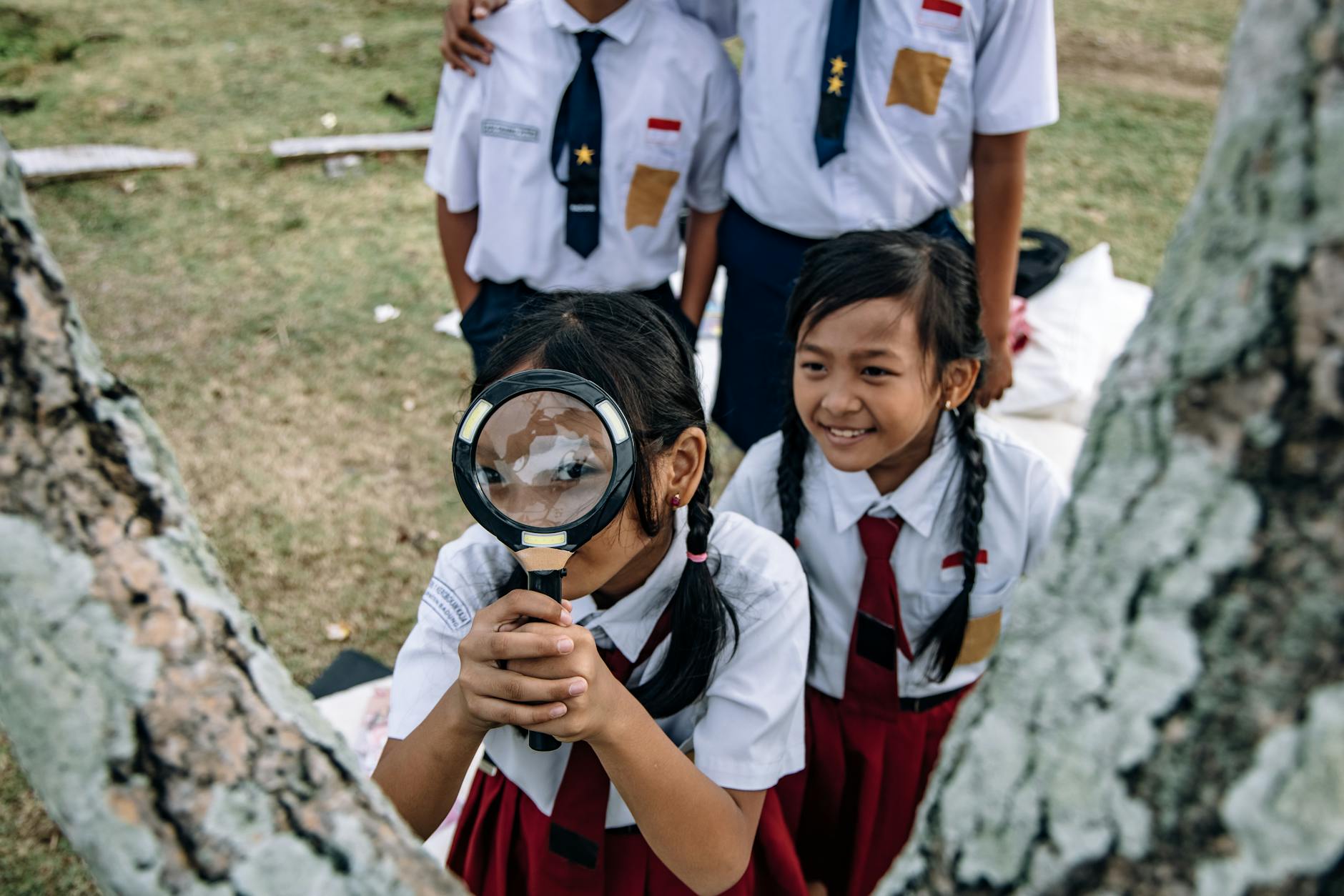
The best science curriculum for young children is the outdoors.
Look at bugs. Catch them gently, observe them closely, let them go. Track what birds come to the yard across seasons. Notice what the sky does before a storm. Watch what happens to a dead log over a year.
This is not "pre-science." This is science. Observation, hypothesis, documentation, pattern-recognition — these are the foundations of scientific thinking, and they develop through sustained attention to the natural world.
Our free nature journal pages support this work — blank pages with space for sketching, date, weather, and observation notes. Download free.
Free Online Resources
Khan Academy Science. Comprehensive, free, self-paced science instruction from elementary through high school. The videos are clear, the practice problems are well-designed, and the whole thing requires no registration.
CK-12. Free interactive textbooks for grades 6-12 in science and math. Students can read, watch videos, and take practice assessments all in one place. Genuinely high quality.
NASA Education. Free lesson plans, activities, and data sets for all ages. The image galleries alone are worth visiting regularly. nasa.gov/education
iNaturalist. A community science platform where users document observations of plants and animals. Your child's observations can become actual scientific data — submitted to real databases used by researchers. The app is free. inaturalist.org
NOAA Education. For weather, ocean, and atmospheric science. Real data, visualizations, and curriculum resources. education.noaa.gov
PhET Simulations. From the University of Colorado. Interactive science and math simulations — virtual physics, chemistry, biology, and earth science experiments. Free, no installation required. phet.colorado.edu
Living Books for Science
The Charlotte Mason tradition values living books — books written by people who love their subject, that bring the material to life rather than presenting it as inert facts.
A few favorites:
- The Periodic Table by Primo Levi (chemistry through human stories)
- A Short History of Nearly Everything by Bill Bryson (accessible introduction to science history and major discoveries)
- The Hidden Life of Trees by Peter Wohlleben (botany and ecology through the lens of a forester)
- Humble Pi by Matt Parker (the fascinating world of mathematical error)
These are not textbooks. They are books that make curious people more curious.
Science Notebooks
A dedicated science notebook is one of the most valuable tools in a home science education. Every observation, every experiment, every question gets recorded.
The key elements of a good lab record: date, hypothesis, what you did, what you observed, what you concluded. This is the scientific method, practiced not as a worksheet exercise but as an actual way of recording and thinking about the world.
The same notebooking pages from our free resource pack work well for science — the open format accommodates sketches, diagrams, and data tables as naturally as written narration.
Experiments With What You Already Have
You do not need a kit. Some of the best science experiments use things already in your kitchen.
Baking soda and vinegar is obvious, but the observation question matters: why does it fizz? What gas is produced? What happens if you change the ratio? Turn a simple reaction into a systematic investigation by changing one variable at a time and recording results.
Oil and water density experiments. Growing plants from seed and measuring growth daily. Tracking the weather and building a local data set over weeks. Evaporation experiments with different surfaces. Making a simple compass with a needle, a magnet, and a bowl of water.
The key is not the experiment itself but the habit of asking "what will happen?" before doing it, recording what actually happens, and then asking "why?" The experiment is a vehicle for scientific thinking.
Science for Middle and High School
This is where many homeschool families feel the most anxiety. Is what we are doing rigorous enough? Can I really teach chemistry or physics at home?
Mostly, yes. Here is how to think about it.
Biology and earth science are highly accessible at home. Nature study, iNaturalist, the resources above, and a good living book or library book are genuinely sufficient for a solid foundational education in these disciplines.
Chemistry is harder to do hands-on at home, but the conceptual foundation is absolutely teachable with Khan Academy and CK-12, supplemented by excellent YouTube channels like Tyler DeWitt (free, extraordinarily clear chemistry videos aimed at high schoolers).
Physics pairs well with PhET simulations for conceptual understanding, and with real experiments involving motion, force, and basic mechanics that you can do with household objects or cheap supplies.
For a transcript-worthy high school science credit, combine any of these free resources with a lab component, which can be as simple as consistent, documented experiments over the year, and a reading component using living books or library books. Document what you covered. That documentation is the curriculum.
What About Science Kits?
They are fine if you enjoy them. They are not necessary.
The appeal of a science kit is that it removes planning. Someone has assembled the materials and the instructions and the learning objective. If that reduces friction enough to make science happen regularly, the kit has done its job.
The limitation is that kits tend to produce predetermined results rather than genuine inquiry. The child follows steps and produces the expected outcome. This is closer to cooking from a recipe than to scientific investigation.
If you use kits, add a question: "What would happen if we changed this?" That addition turns a demonstration into an experiment.
The One Thing That Builds Real Scientific Thinking
The habit that does more than any resource or curriculum is this: asking "why?" and then looking for the answer together rather than simply supplying it.
When your child notices something, asks a question, or makes an observation, the most scientifically formative response is not to answer it immediately. It is to say: "That is a good question. What do you think? How could we find out?"
This habit, practiced consistently across years, produces a child who approaches the world the way scientists approach it. Not as a collection of facts to be received, but as a set of phenomena to be understood.
No curriculum delivers that. You do.
Nature study for beginners covers the outdoor science approach in more depth. And free homeschool resources is the full collection of printables we offer.
Written by
The High Vibe Homeschool Team
We are a homeschool family that has been doing this for seven years across three kids. We write about what we have actually tried, what failed, what surprised us, and what we would do again. No credentials. Just lived experience.
ENJOYED THIS ARTICLE?
Get more like it every week
Real homeschool life, in your inbox.
Keep Reading
More in Resources
 Resources
Our Favorite Read-Alouds for Every Age (That the Whole Family Actually Loves)
Read-alouds are the heartbeat of our homeschool day. Here are the books that made our kids beg us to keep reading — sorted by age so you can find your next one fast.
 Resources
Yes, Audiobooks Count. Here's How We Use Them.
Audiobooks are not a shortcut or a lazy day substitute. In our homeschool, they are a core tool. Here's exactly how we use them and why listening absolutely counts as reading.
 Resources
10 Books Every Homeschool Mom Should Read (At Least Once)
Not books for your children. Books for you. The ones that changed how we think about education, restored our confidence on the hard days, and gave us the words for what we were trying to do.