Our Favorite Read-Alouds for Every Age (That the Whole Family Actually Loves)
Read-alouds are the heartbeat of our homeschool day. Here are the books that made our kids beg us to keep reading — sorted by age so you can find your next one fast.
A little note: Some links in this post are affiliate links. If you click through and buy something, we earn a small commission at no extra cost to you. We only ever link to things we would genuinely recommend to a friend.
If there is one thing I wish someone had told me at the very beginning of our homeschool journey, it is this: read aloud every single day, for as long as you possibly can.
Not because it is on the curriculum checklist. Not because some expert said so. But because the hour you spend curled up on the couch reading together becomes the hour everyone remembers. It is the thing my kids ask for when everything else falls apart. It is where we have laughed the hardest, cried together, and had some of the best conversations of our lives.
So here are the books that have earned permanent spots on our shelves, sorted loosely by age so you can find your next read-aloud fast.
For the Littles (Ages 4-7)
Short chapters, a brave little boy, a baby dragon in need of rescue, and just enough danger to make small listeners grip the sofa cushion. This is the book that turned my reluctant listener into someone who asked to skip lunch to hear what happened next. There are two sequels. You will need them both.
Tiny people living under the floorboards, borrowing thimbles and postage stamps to furnish their home. Mary Norton writes with such specificity that children absolutely believe it is real. We had to institute a "no checking under the floorboards" rule.
A girl who lives alone, lifts a horse over her head, and refuses to be told what to do by anyone. Pippi is chaotic and delightful and my daughter still references her when she wants to justify something inadvisable.
A Few More for the Youngest Listeners
The Beatrix Potter tales work beautifully for ages four and five, read one or two per sitting. The language is more formal than modern picture books, which is part of the point. Children at this age absorb vocabulary without any effort when the story is engaging.
Mr. Popper's Penguins is a quick, funny read for families with slightly older listeners in this range. Twelve penguins in a small house. Everything that could go wrong does.
For the Middle Years (Ages 7-11)
A bored boy drives through a magic tollbooth and ends up in a land where words and numbers are at war. This book is a love letter to curiosity and learning, disguised as an adventure story. It rewards being read slowly. Read it slowly.
You already know about this one, and yet. There is something about reading it aloud, with your voice catching on the last few chapters, that makes it land differently than any child reading it alone ever could. This is the one that teaches kids that love and loss can exist in the same sentence.
Start with this one even if you plan to read the whole Chronicles of Narnia. The first time a child hears "He is not a tame lion" out loud, something shifts. The whole series is worth it. Plan about a year.
Laura Ingalls Wilder writing about her own childhood is deceptively simple and completely immersive. My kids started asking questions about pioneer life, food preservation, and how to make a door out of logs. This series is social studies, history, and literature all at once, and nobody notices.
Others That Have Earned Our Loyalty in This Age Range
The Wonderful Wizard of Oz reads completely differently aloud than it does silently. L. Frank Baum's cadence is made for reading out loud and children who think they know the story from the movie are consistently surprised by what is actually in the book.
Stuart Little, The Trumpet of the Swan, and Charlotte's Web form a natural E.B. White trilogy for this age. Stuart Little first, because it is lighter. Charlotte's Web last, because nothing follows it well.
Mary Poppins is darker and stranger than the film and genuinely better for it. Read at least the first two books.
For the Older Crowd (Ages 10 and up)
Tolkien's prose is rich enough that hearing it read aloud is genuinely better than reading it silently. If you have been waiting for the "right time" to introduce Middle-earth, there is no wrong time. Start here, not with The Lord of the Rings. The Hobbit is the on-ramp and it is a beautiful one.
Meg Murry is awkward and overlooked and saves the universe anyway. This book has been making kids feel less alone for sixty years. It holds up. Completely.
Read this one when your kids are old enough to sit with an uncomfortable ending and talk about it. The conversations it generates about freedom, memory, and what makes a life meaningful are worth every minute.
Pushing Into the Teen Years
When your readers are twelve and older, the read-aloud can go deeper than most families expect.
Watership Down is the one I did not think we could pull off as a read-aloud. We did. Three hundred and forty pages about rabbits that is actually about leadership, courage, and what it means to build a community. My oldest still talks about Hazel.
The Screwtape Letters by C.S. Lewis is a short, strange, brilliant book that works well with teenagers who can hold an ironic frame. A senior demon writing letters to a junior demon on how to corrupt a soul. The conversations it generates depend entirely on where your family is, but they are almost always interesting.
Johnny Tremain is the Revolutionary War novel I had never heard of before a homeschool friend recommended it. Silversmith apprentice, Boston in 1775, the Sons of Liberty. Historically meaty and genuinely gripping. We read it alongside our American history study and it turned the period from facts into people.
Free Download
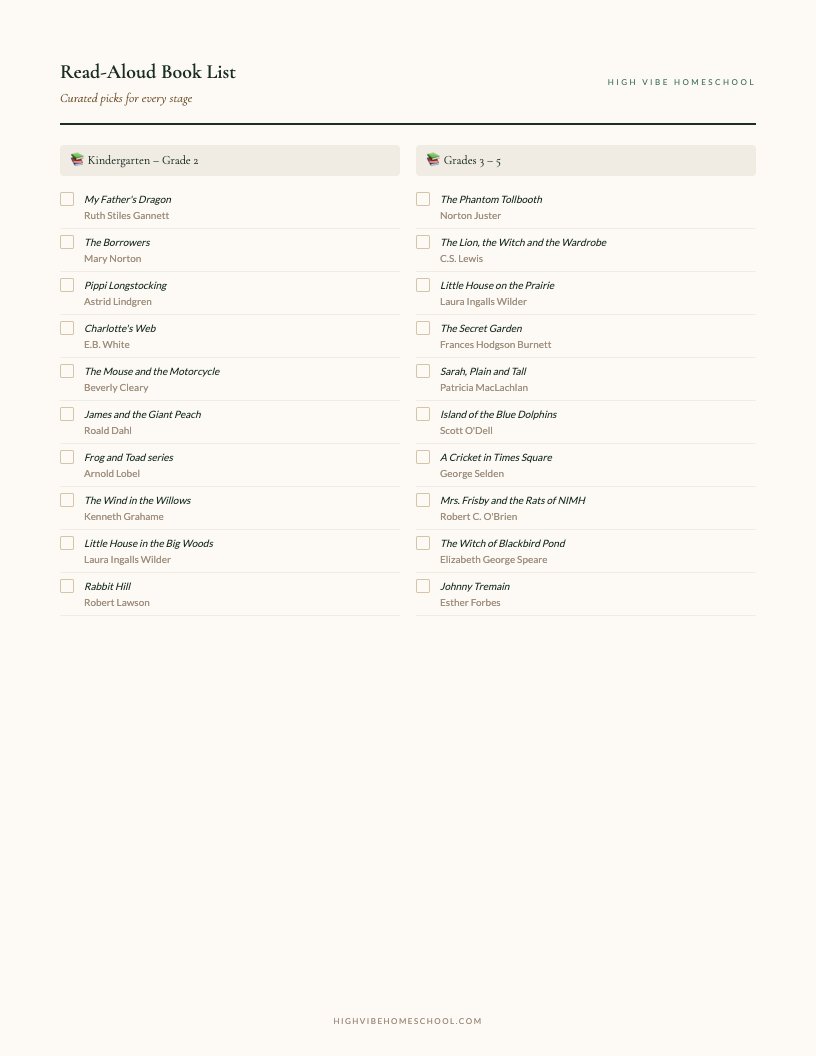
Read-Aloud Book List by Age
Curated read-aloud picks for every stage: K-2, 3-5, and 6-8. Print and check them off as you go.
No spam. Unsubscribe anytime.
How to Keep Read-Aloud Time Going When Life Gets Busy
The families who read aloud consistently for years have one thing in common: they protect the time before something else takes it.
For us, it is after lunch. Not after lunch when nothing else is happening. Just after lunch. Dishes wait. Errands wait. We read first.
Some other patterns that work: thirty minutes before bed as the absolute last thing, morning basket with one chapter before academic work begins, or a dedicated "story hour" on Friday afternoons as a week-closing ritual.
The specific time does not matter. The protection of it does.
If you miss a week, you do not have lost the habit. You have just missed a week. Pick it back up. Do not let a gap become a reason to stop.
The only rule we have around read-alouds is this: whoever is reading gets to decide the voices. No one is allowed to criticize the voices.
That is it. Pick a book from this list, sit down together, and read.
For the families who are new to reading aloud together, audiobooks in our homeschool covers why listening counts — and how we use audiobooks alongside read-alouds. And living books explains the Charlotte Mason distinction between books worth reading and books that just fill time.
Written by
The High Vibe Homeschool Team
We are a homeschool family that has been doing this for seven years across three kids. We write about what we have actually tried, what failed, what surprised us, and what we would do again. No credentials. Just lived experience.
ENJOYED THIS ARTICLE?
Get more like it every week
Real homeschool life, in your inbox.
Keep Reading
More in Resources
 Resources
Yes, Audiobooks Count. Here's How We Use Them.
Audiobooks are not a shortcut or a lazy day substitute. In our homeschool, they are a core tool. Here's exactly how we use them and why listening absolutely counts as reading.
 Resources
10 Books Every Homeschool Mom Should Read (At Least Once)
Not books for your children. Books for you. The ones that changed how we think about education, restored our confidence on the hard days, and gave us the words for what we were trying to do.
 Resources
The High Vibe Homeschool Reading List: 50 Books Across All Ages
A curated reading list of 50 living books for homeschool families — organized by age range and subject, with brief notes on what makes each one worth the time.