Waldorf Homeschooling: What It Is and Whether It Fits Your Family
Waldorf education is more than craft projects and wooden toys. Here is what it actually involves, what makes it distinctive, and the honest truth about who it works well for at home.
A little note: Some links in this post are affiliate links. If you click through and buy something, we earn a small commission at no extra cost to you. We only ever link to things we would genuinely recommend to a friend.
Most people who encounter Waldorf education for the first time come away with one of two impressions.
Some find it beautiful and intuitively right. The rhythm, the arts integration, the reverence for childhood, the resistance to early academics. Something about it feels like it matches what they instinctively believe about how children should grow.
Others find it strange, too spiritual, too craft-heavy, or too resistant to the kind of tangible academic output they can point to.
Both responses are reasonable. Waldorf is one of the most cohesive and philosophically developed educational approaches in existence, which means it is also one of the most distinctive. You will rarely feel neutral about it.
What Waldorf Actually Is
Rudolf Steiner developed Waldorf education in Stuttgart in 1919, initially for the children of Waldorf cigarette factory workers. His philosophy of child development, which he called anthroposophy, held that children develop through distinct stages and that education should match the developmental reality of each stage rather than imposing adult standards prematurely.
The approach is built on three core premises:
Imitation before instruction. Young children learn primarily by imitating the adults around them. They do not need direct instruction. They need beautiful, worthy things to imitate.
Arts integration throughout. Every subject is taught through art. Math through movement and rhythm. History through dramatic storytelling. Language arts through poetry and painting. The arts are not add-ons. They are the primary mode of teaching.
Rhythmic structure. Daily, weekly, and yearly rhythms are central. The same activities happen at the same time each day. The curriculum moves through a predictable cycle of themes across the year. Predictability creates security; security enables learning.
The Distinctive Features of Waldorf at Home
No reading instruction before age six or seven. Waldorf waits deliberately. Children learn to love language through stories, rhymes, and songs before they learn to decode text. For parents accustomed to conventional academic timelines, this requires significant trust.
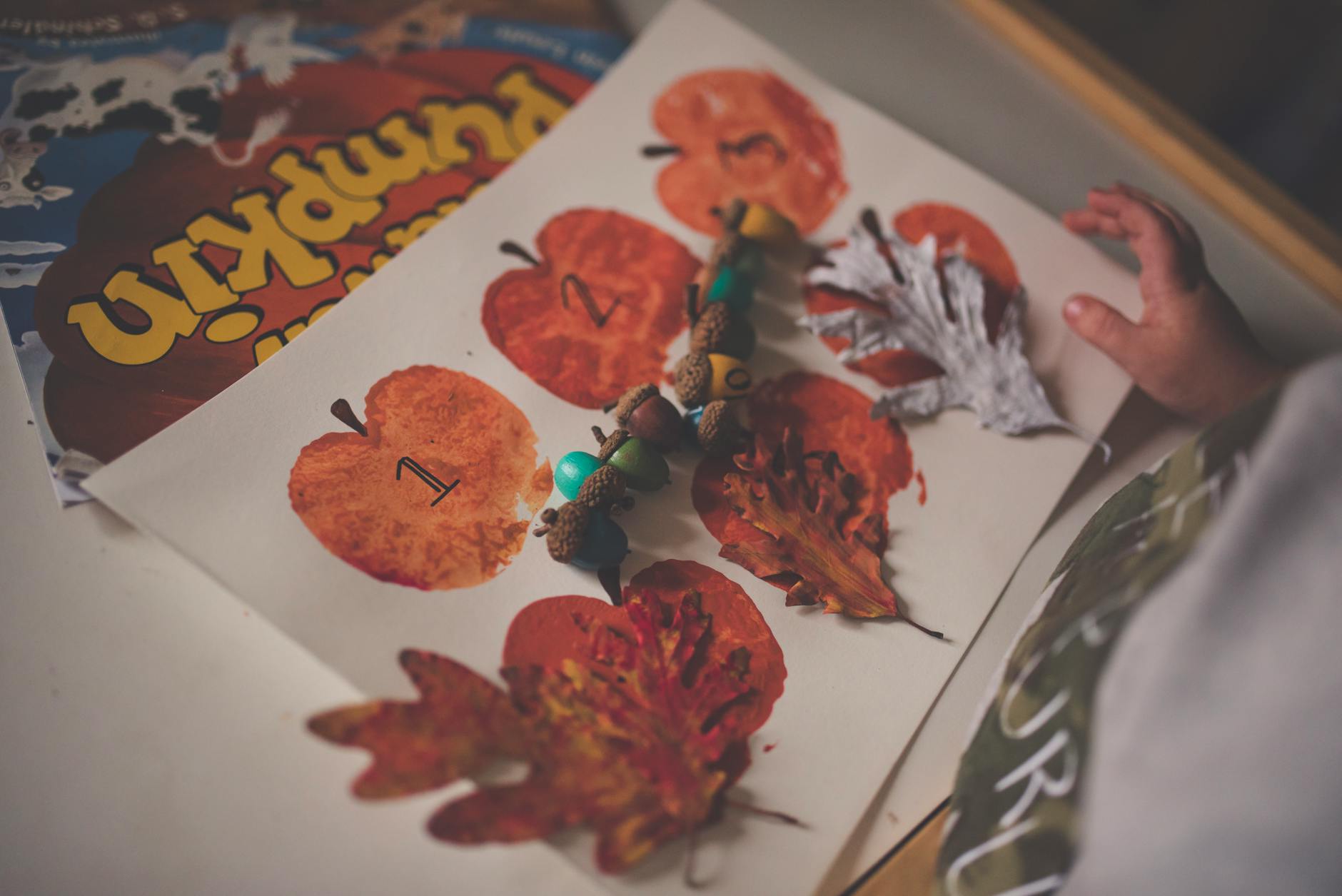
Main lesson books instead of textbooks. Students create their own books as they go. They draw, write, and paint their way through every subject. These books become a record of the learning year.
Seasonal and nature connection. The curriculum moves with the natural year. Autumn is harvest, ancestors, root vegetables, darkness. Spring is planting, resurrection stories, green growth. The natural world is not an enrichment add-on; it is the curriculum's spine.
Storytelling as primary pedagogy. In the early grades, the teacher tells stories. Not reads from books. Tells, from memory, with expression, eye contact, and the particular quality of a voice alive to the material. For homeschooling parents, this means learning to be storytellers.
Wet-on-wet watercolor. The particular Waldorf watercolor technique, using wet paper and very fluid paint to create soft, blending images, is practiced in every Waldorf school. It is beautiful and produces a quality of attention that other media do not.
The Waldorf Curriculum Sequence by Age
Waldorf has a specific philosophy about what is appropriate at each developmental stage. Here is a rough sketch:
Grades 1-3 (ages 6-9): The curriculum is built around fairy tales, nature stories, and legends. Math is taught through movement and storytelling. Reading emerges from writing, which emerges from drawing. The goal is to nurture imagination and lay roots, not to demonstrate early academic performance.
Grades 4-6 (ages 9-12): Stories become more complex. Norse mythology. Ancient civilizations — India, Persia, Egypt, Greece, Rome. Local geography and natural history. The child is developmentally ready for more complexity, and the curriculum matches this.
Grades 7-9 (ages 12-15): Biography, Renaissance, exploration, revolution. Science becomes more formal. The curriculum mirrors the adolescent's growing sense of self in history and in the world.
Grades 10-12 (ages 15-18): Full academic engagement. The earlier foundation shows here — children who have been educated this way often arrive at advanced subjects with an unusual quality of engagement and imagination.
This sequence is one of Waldorf's most appealing qualities for families who think in the long arc. The early years are not preparation for later years. Each stage is complete in itself, and the curriculum is designed with that in mind.
Practical Resources for Waldorf at Home
The best starting point for homeschooling parents:
The Christopherus Homeschool Resources curriculum is one of the most widely used Waldorf homeschool programs. Donna Simmons's guides are practical, thoughtful, and written specifically for home settings.
For young children, the picture books of Elsa Beskow are the most Waldorf-aligned literature available and are genuinely beautiful regardless of your educational philosophy.
Who Waldorf Works Well For
Families who are comfortable with slow, unhurried development and do not need to see early academic output to feel confident. Parents who are genuinely drawn to craft, art, and nature. Children who are imaginative, sensitive, and thrive with predictable rhythms.
It also tends to work well for families who have the bandwidth to put some effort into the parenting environment, not just the school hours. Waldorf education in a home context is shaped significantly by what the home itself is like: whether screens are limited, whether the pace is gentle, whether the adults in the house are doing real, visible work that children can observe and imitate.
A Waldorf homeschool in a chaotic household with unlimited media is going to struggle to produce the quality of attention and imagination Waldorf is built around. This is not a criticism. It is just an honest look at what the approach requires.
Honest Limitations
Waldorf's philosophical and spiritual roots in anthroposophy are not everyone's cup of tea. The etheric, astral, and ego body language of Steiner's original writings can feel foreign. You do not have to accept anthroposophy to use Waldorf methods, but you will encounter it.
Waldorf's resistance to early academics is also genuinely hard for parents who feel social pressure to "keep up." A seven-year-old who has not yet started reading instruction when conventionally schooled peers are reading chapter books requires real confidence in the approach.
The transition out of Waldorf can also be a challenge. Children who have been educated in a deeply Waldorf way and then enter a conventional school or university at fifteen or sixteen sometimes require a transitional period to adapt to different expectations and formats. This is manageable, but worth knowing going in.
The families who do Waldorf well have usually gone deep into the philosophy, not just adopted the aesthetics. The rhythm, the arts, the storytelling — these work best as a coherent system, not as isolated elements borrowed from a largely conventional approach.
Borrowing from Waldorf Without Going All In
Many families who would not call themselves Waldorf homeschoolers draw significantly from the approach.
The main lesson book concept is valuable regardless of your overall philosophy: letting children create their own illustrated record of what they have learned produces both retention and a beautiful artifact. You do not need to commit to Waldorf to start doing this.
The storytelling pedagogy is applicable everywhere. History told as story rather than as a list of dates and facts is more engaging and more memorable for any child, not just Waldorf children.
The seasonal rhythm is appealing to many families, and building a curriculum that moves with the natural year has a grounding quality that is hard to replicate other ways.
If you are drawn to these elements but not ready to commit to the full approach, start with one. Add the main lesson books. Learn one story by heart and tell it at bedtime rather than reading it. Put a seasonal nature table in your kitchen. See what happens. You will know quickly whether the philosophy fits.
Waldorf and Charlotte Mason are the two most richly developed homeschool philosophies. They overlap in their reverence for childhood and their resistance to early academics, but take very different approaches to curriculum. And choosing a homeschool style maps where both fall in the wider landscape.
Written by
The High Vibe Homeschool Team
We are a homeschool family that has been doing this for seven years across three kids. We write about what we have actually tried, what failed, what surprised us, and what we would do again. No credentials. Just lived experience.
ENJOYED THIS ARTICLE?
Get more like it every week
Real homeschool life, in your inbox.
Keep Reading
More in Curriculum
 Curriculum
Math Games That Make Numbers Come Alive (Even for the Kid Who Hates Math)
My son cried at math worksheets for two years. Then we found games. Here are the ones that changed everything — no flashcards required.
 Curriculum
Living Books: What They Are and How to Find Them
Charlotte Mason's term for books that feel alive. Here's what makes a book 'living,' why it matters, and a list of the ones that have done the most for our homeschool.
 Curriculum
Teaching Writing at Home (When You Don't Feel Like a Writing Teacher)
Writing is the subject most homeschool parents fear most. Here's how we finally made it work — and the approach that produces the most growth for the least friction.