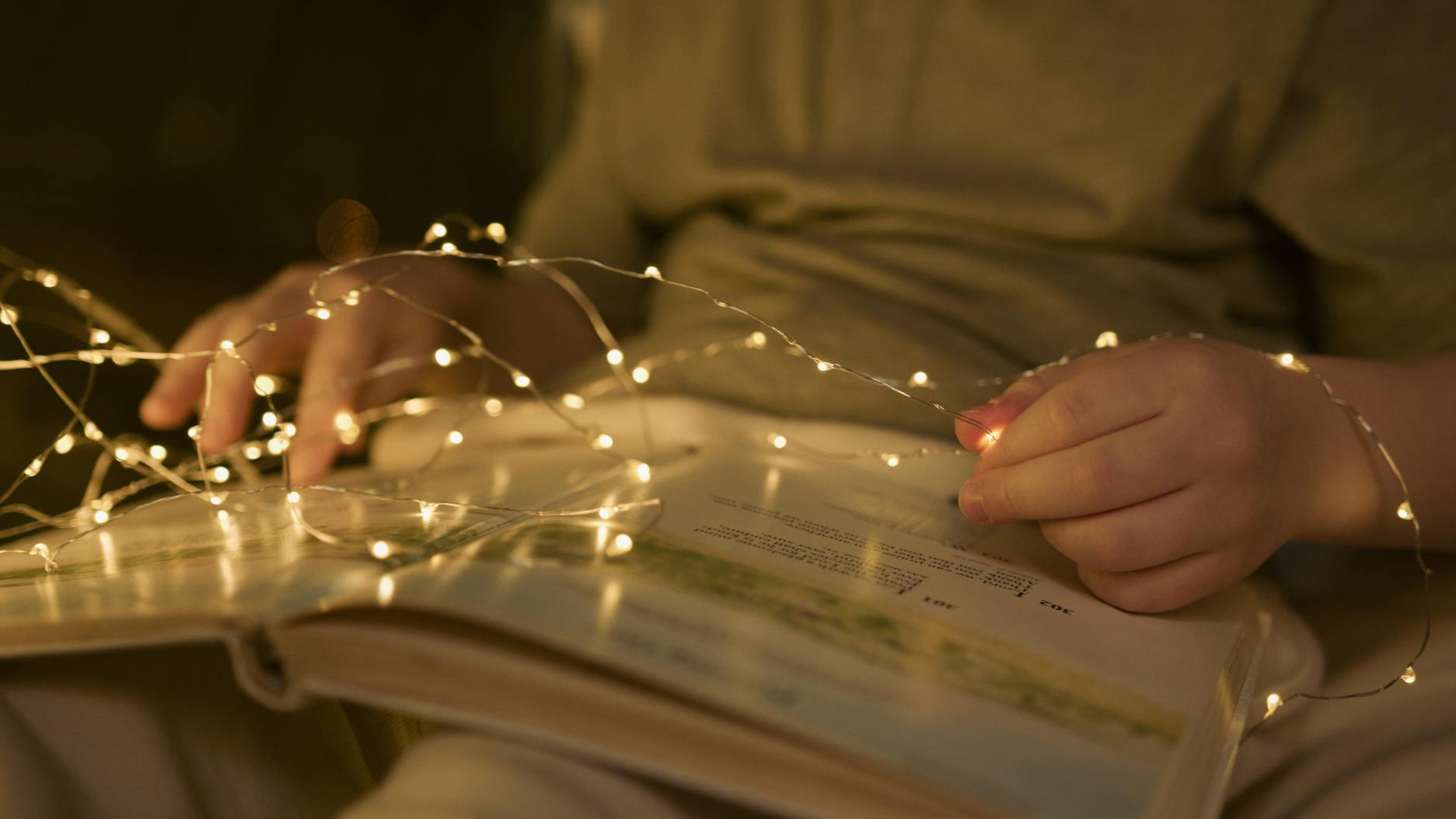
Living Books: What They Are and How to Find Them
Charlotte Mason's term for books that feel alive. Here's what makes a book 'living,' why it matters, and a list of the ones that have done the most for our homeschool.
A little note: Some links in this post are affiliate links. If you click through and buy something, we earn a small commission at no extra cost to you. We only ever link to things we would genuinely recommend to a friend.
Charlotte Mason had a phrase for the books that made children lean forward.
She called them living books.
The contrast was with what she called "twaddle" on one end and dry textbooks on the other. Twaddle is content that talks down to children, uses artificially simple language, and assumes kids cannot handle real ideas. Textbooks (at their worst) present information without a person behind it, a kind of flattened recitation of facts with no soul.
Living books are something else entirely. A real person, writing with genuine knowledge and conviction about something they love, in language that is clear but not dumbed down. You can feel the author in the book. That feeling is what makes the information stick.
What Makes a Book "Living"
The test I use is simple: when I read it aloud, does it sound like a person talking, or like a reference entry?
Living books usually have:
A narrative thread. Even if the subject is science or history, there is a story moving through it. Things happen in sequence, cause leads to effect, characters face real choices.
An author with a point of view. Not opinion journalism, but genuine authority. Someone who studied spiders for thirty years writes differently about spiders than someone who summarized a Wikipedia article.
Language worth reading aloud. You want children to encounter good prose the way they encounter good music. Alive, varied, surprising.
Respect for the reader. The best children's writers do not simplify their ideas. They simplify their sentences and trust the reader to follow.
What "Twaddle" Actually Means (and Why It Matters)
Mason's term twaddle is sometimes misunderstood. It is not about difficulty. A simple picture book can be a living book. A dense textbook can be twaddle.
The distinction is about the quality of the mind behind the writing. Twaddle is writing that does not take the child seriously as a thinking person. It over-explains. It talks down. It uses artificially simple vocabulary not because simplicity is right for the subject, but because someone assumed children could not handle more.
The odd thing about twaddle is that children often know. They tolerate it, but it does not stick. They do not ask for it again. The living book is the one they want to hear one more time, the one they remember three years later, the one that changes how they see something.
You do not need to be able to define twaddle precisely to recognize it. Read the first two pages aloud. Do you feel like a person talking to you, or like a voice reading a fact sheet?
Our Favorite Living Books by Subject
History
This is where living books shine brightest. Jean Fritz writes American history as biography, and each book reads like a story about a person who had something at stake.
For ancient history, Genevieve Foster's "World of..." series takes a single figure and maps everyone alive at the same moment. My son started asking questions about Alexander the Great because of a single chapter in a Foster book.
For the American Revolution period, we have returned to Johnny Tremain more than once. It is the kind of book where history stops feeling like background noise and starts feeling like something people lived.
Science
Comstock's Handbook of Nature Study is four hundred years of naturalist tradition in one volume. Thick enough to use as a doorstop. Dense enough to last a decade.
Holling C. Holling's illustrated science-story books (Paddle-to-the-Sea, Minn of the Mississippi, Pagoo) taught my children more about ecosystems than any curriculum unit we ever purchased.
The Pagoo book in particular, which follows the life cycle of a hermit crab, produced three weeks of spontaneous interest in tide pools and marine biology. That is what a living book does. It opens a door that the child walks through on their own.
Biography
Biography is one of the most reliable living-book genres for children. A real person, real choices, real consequences. Jean Fritz is the master of this for American history. Diane Stanley writes outstanding picture-book biographies of figures like Leonardo, Michelangelo, and Cleopatra that work for a wide age range.
Literature and Poetry
The anthology Childcraft has been in and out of print for decades, but used copies circulate endlessly. The poetry volumes are particularly good. Robert Louis Stevenson, Eleanor Farjeon, Christina Rossetti.
Where to Find Living Books
Used bookstores are the best source. Charlotte Mason families have been building lists for a hundred years. You will find treasures in the biography section of any decent used shop.
Ambleside Online maintains a free living book curriculum organized by year. Even if you don't use their full curriculum, the book lists alone are worth bookmarking.
The library first, always. Before buying any book, check if the library has it. Borrow, read aloud together, and only buy the ones you want to own permanently.
Interlibrary loan for the obscure stuff. Many of the best living books are out of print. ILL gets them to you for free.
ThriftBooks and AbeBooks are good for sourcing out-of-print titles online. We have found multiple Genevieve Foster and Holling Holling books through ThriftBooks for a few dollars each.
How to Evaluate a Book Before Buying
Read the first page. Then read a page from the middle. Ask:
Is there a human being behind this writing? Does the author care about this subject? Is the language doing anything interesting, or is it just conveying information?
Can you picture reading this aloud? Would the child in front of you want to hear what happens next, or would they be listening politely?
If you are buying sight unseen online, look up the book on Ambleside Online's list or on the Simply Charlotte Mason website. Both maintain curated living book recommendations by subject and age, and both are run by people who have thought carefully about this question.
A Note on What Is Not a Living Book
Boxed curricula reading lists often include plenty of living books. But the comprehension worksheets that follow them often kill what made the books living in the first place.
A living book requires narration, not interrogation. "Tell me what happened" produces different work in a child's mind than "circle the best answer." The first invites synthesis. The second invites retrieval.
This is worth being concrete about. After reading a chapter of Paddle-to-the-Sea, asking the child to narrate back what happened produces retention, reflection, and connection-making. Handing them a worksheet with five comprehension questions produces five answered questions and very little learning.
The book is only half the equation. What you do after the reading matters just as much.
Building a Living Book Library Over Time
You do not need hundreds of books immediately. Start with the subjects you are covering now, find one or two strong living books for each, and build from there.
A few anchors that belong in almost any homeschool library: the Holling books for science and geography, Jean Fritz biographies for American history, a good poetry anthology, and D'Aulaires' books on Greek and Norse mythology for those early mythology years.
Everything else can come from the library until you know which books your family wants to own.
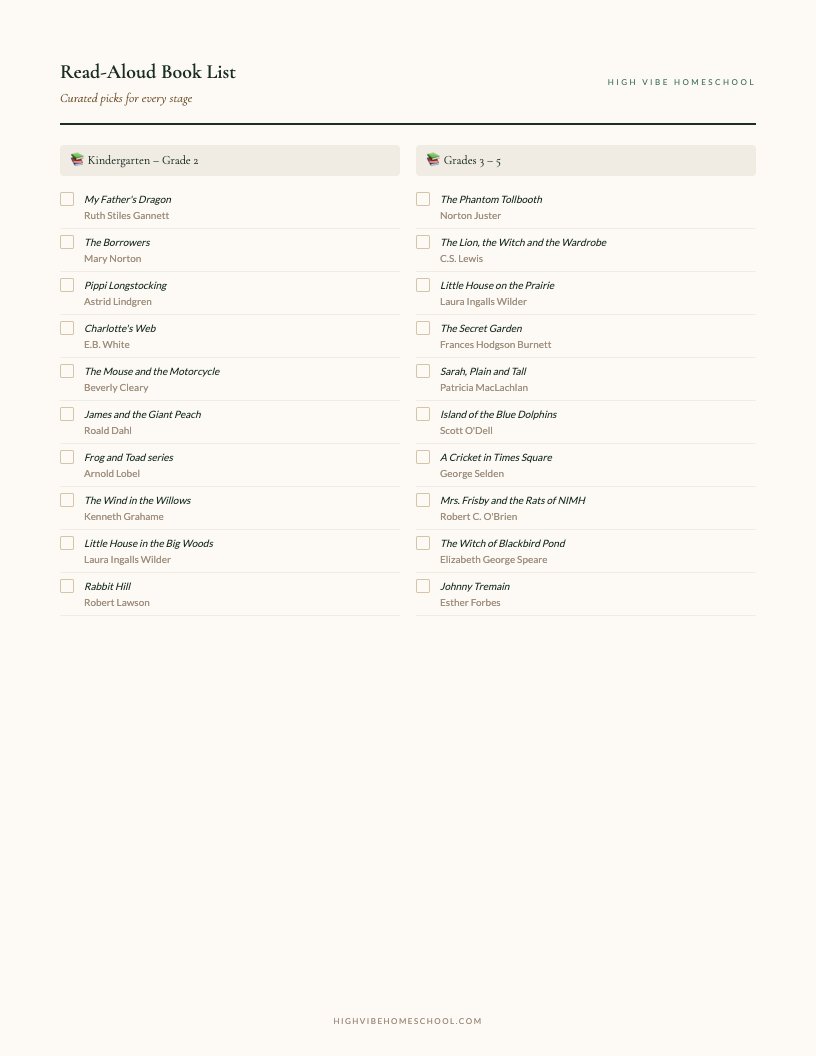
Free Download
Read-Aloud Book List by Age
Curated read-aloud picks for every stage: K-2, 3-5, and 6-8. Print and check them off as you go.
No spam. Unsubscribe anytime.
Our favorite read-alouds for every age is the curated list of the living books we return to most. And Charlotte Mason for beginners provides the philosophy that explains why living books matter so much.
Written by
The High Vibe Homeschool Team
We are a homeschool family that has been doing this for seven years across three kids. We write about what we have actually tried, what failed, what surprised us, and what we would do again. No credentials. Just lived experience.
ENJOYED THIS ARTICLE?
Get more like it every week
Real homeschool life, in your inbox.
Keep Reading
More in Curriculum
 Curriculum
Math Games That Make Numbers Come Alive (Even for the Kid Who Hates Math)
My son cried at math worksheets for two years. Then we found games. Here are the ones that changed everything — no flashcards required.
 Curriculum
Teaching Writing at Home (When You Don't Feel Like a Writing Teacher)
Writing is the subject most homeschool parents fear most. Here's how we finally made it work — and the approach that produces the most growth for the least friction.
 Curriculum
Classical Education: What It Actually Is and Whether It's Right for Your Family
Classical education is having a revival. Here's an honest explanation of the trivium, who it works for, who it does not, and what the best resources look like.