
Teaching History at Home: The Approach That Actually Makes It Stick
History taught from a textbook produces one kind of learning. History taught through stories, timelines, and living books produces something entirely different. Here is how we do it.
A little note: Some links in this post are affiliate links. If you click through and buy something, we earn a small commission at no extra cost to you. We only ever link to things we would genuinely recommend to a friend.
The version of history I learned in school was a series of dates and names to memorize for tests.
I could tell you that the Civil War started in 1861 and that Lincoln issued the Emancipation Proclamation in 1863. What I could not tell you, through most of my adult life, was why any of it felt like it mattered.
History taught well produces something different. It produces the understanding that people in the past were people, making decisions under pressure with incomplete information, in circumstances not entirely unlike our own. That understanding is one of the most practically useful things education can give a person.
Here is how we have tried to get there.
The Chronological Approach
We teach history chronologically. Ancient civilizations first, then the medieval period, then early modern, then modern. We cycle through this sequence over four years and then repeat it at greater depth.
The logic is simple: later events make more sense when you understand the earlier events that led to them. The Renaissance is more interesting if you know what the medieval period looked like. The American Revolution is more interesting if you have studied how English constitutional history developed. Chronology is not the only way to teach history, but it is the way that produces the most coherent understanding.
The best single spine for this approach at the elementary level:
Susan Wise Bauer's Story of the World series covers ancient through modern history across four volumes, written for children but genuinely engaging for adults too. We read it aloud and the conversation it produces is consistently better than any other history text we have used.
Timelines: The Physical Record
We keep a timeline. A long strip of paper along one wall of our schoolroom, marked with dates, that grows as we move through history.
Every significant person, event, or era gets a card. The child writes or draws the entry themselves.
This is not decorative. It is cognitive. Having a physical, spatial representation of when things happened, in relation to each other, produces a kind of understanding that no list of dates can replicate. My children can walk down the timeline and tell you that Confucius and Socrates were alive at roughly the same time, that the fall of Rome and the early Islamic caliphates overlapped, that Shakespeare was born the year Columbus died.
These connections would take me weeks to teach explicitly. The timeline teaches them incidentally, just by existing.
You do not need a special purchased timeline. Butcher paper, a ruler, and a Sharpie is enough to start. Hang it low enough that the children can reach it.
Primary Sources, Carefully Chosen
From early on, we read from primary sources alongside our narrative history.
For young children, this does not mean dense original documents. It means excerpts, adapted lightly if necessary, that let the child hear the voice of a person from the time.
A letter from a soldier at Gettysburg. A description of daily life in ancient Rome. A speech. A diary entry. A petition.
These serve a purpose that no secondary account can: they make it plain that the past was populated by people who had thoughts and feelings and wrote them down. History becomes less like a story that was made up and more like something that actually happened.
Historical Fiction as Supplement
Good historical fiction, woven in alongside the nonfiction spine, does things nonfiction cannot.
It puts you inside a person living through an event. It makes you care about the outcome. It creates the emotional resonance that makes historical facts memorable.
The Across Five Aprils series for the Civil War. The Bronze Bow for Roman-era Judea. The Witch of Blackbird Pond for Puritan New England. Number the Stars for World War II.
None of these are substitutes for factual history. All of them have made the factual history mean more to my children than it would have otherwise.
Narration as the Main Assessment
We do not test history.
Instead, after every reading session, I ask one of the children to tell me what they remember. This is narration, Charlotte Mason's approach to comprehension and retention.
The rule is simple: tell me back what you heard. No prompts, no fill-in-the-blank. Just what they remember, in their own words.
Narration works because retrieving information produces stronger retention than being tested on it. And it immediately tells you what the child actually understood, not what they can recognize on a multiple choice test. When a child gives a coherent narration about a topic, they understood it. When the narration is confused or thin, you know where to go back.
Written narration, where a child writes out what they remember instead of saying it, works well from around third grade. The transition from oral to written narration is usually gradual. Some children resist it; short written narrations on index cards are less intimidating than a whole blank page.
Making History Visual Beyond the Timeline
History sticks better when it has multiple representations.
Maps are the most useful. After any reading about a place, we find it on a map. My children did not know where Mesopotamia was before we started studying ancient history. By the time we finished that unit, they could point to the Tigris and Euphrates without hesitating.
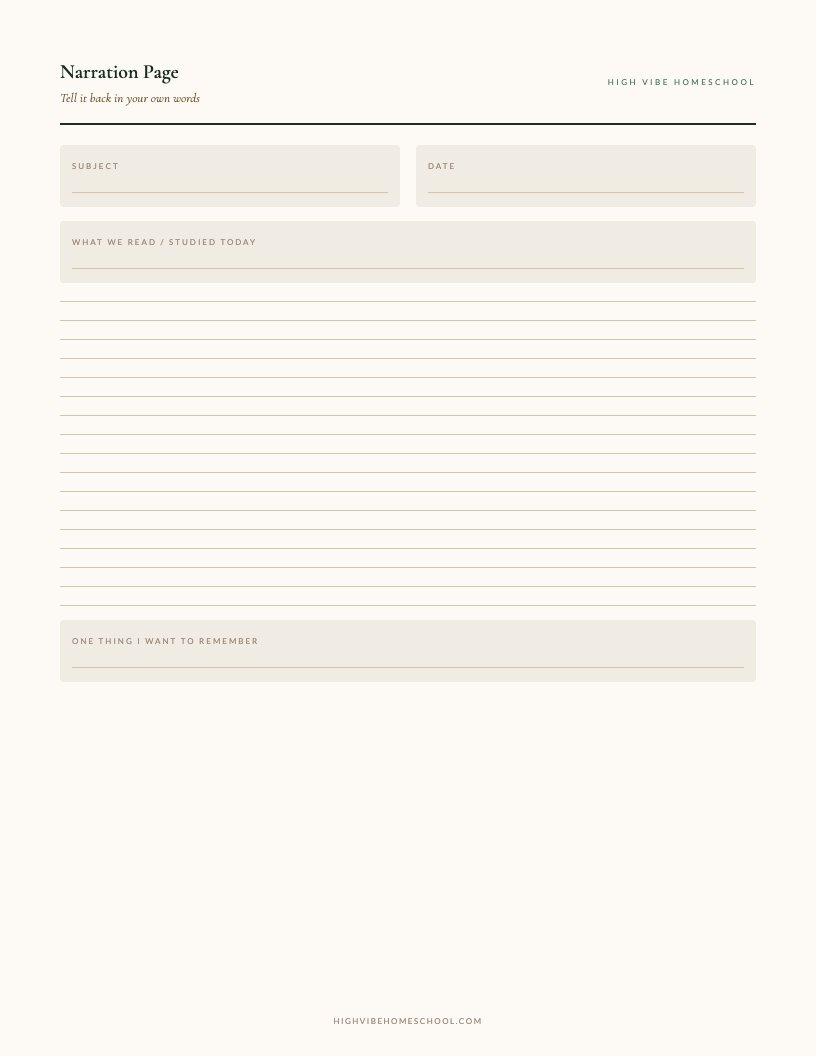
Notebooking is the other visual tool we use consistently. A history notebook is a personal reference book the child builds over the year. Each page records something from the period we are studying: a drawn portrait of a historical figure, a fact about daily life, a sketch of an important building. These notebooks become something the children are proud of in a way workbooks rarely produce.
Free Download
Charlotte Mason Notebooking Pages
4 pages for recording what your child is learning: lined narration, drawing box, nature entry, and free study.
No spam. Unsubscribe anytime.
Common Questions About History at Home
Do I need a curriculum? No. A narrative spine, a library card, and a timeline are enough. Story of the World has an activity guide worth having. Beyond that, the library will provide more than you can use.
What if I do not know enough history to teach it? Neither did I when we started. Learn alongside your children. You are reading the same books they are. Your honest "I do not know, let's find out" is better modeling than any authority performance.
How do I handle history that is uncomfortable or contested? Honestly, and age-appropriately. Slavery, conquest, and genocide happened. Children who are taught honest history are better equipped to understand the present than children who were given a curated version. The question is not whether to include difficult history but how to present it in a way a child can process. That depends on the child and the age.
Should I follow state standards? It depends on your state's documentation requirements. For most families, a chronological approach that covers world and American history in a four-year cycle will exceed most state social studies standards without any special alignment work.
What We Avoid
Teaching history as an opportunity for contemporary moral lessons. The past is more interesting and more instructive when you try to understand it on its own terms, not as a vehicle for delivering a predetermined message. Children who are taught to see historical figures primarily as examples of contemporary virtues or vices learn less about history and less about how to reason.
Skipping the hard parts. Slavery, conquest, genocide, religious persecution. The history that makes us uncomfortable is often the history that most needs to be understood. Age-appropriate honesty is better than comfortable omission.
Rushing. History is the subject that rewards going slowly more than almost any other. Two weeks on ancient Egypt is better than two days. The depth of engagement that comes from lingering in a period — reading multiple books about it, doing projects in it, following curiosity into side topics — is qualitatively different from survey coverage.
Teaching history through living books is the Charlotte Mason approach to the same subject. And unit studies are the curriculum structure that lets you go deep into a historical period rather than just covering it.
Written by
The High Vibe Homeschool Team
We are a homeschool family that has been doing this for seven years across three kids. We write about what we have actually tried, what failed, what surprised us, and what we would do again. No credentials. Just lived experience.
ENJOYED THIS ARTICLE?
Get more like it every week
Real homeschool life, in your inbox.
Keep Reading
More in Curriculum
 Curriculum
Math Games That Make Numbers Come Alive (Even for the Kid Who Hates Math)
My son cried at math worksheets for two years. Then we found games. Here are the ones that changed everything — no flashcards required.
 Curriculum
Living Books: What They Are and How to Find Them
Charlotte Mason's term for books that feel alive. Here's what makes a book 'living,' why it matters, and a list of the ones that have done the most for our homeschool.
 Curriculum
Teaching Writing at Home (When You Don't Feel Like a Writing Teacher)
Writing is the subject most homeschool parents fear most. Here's how we finally made it work — and the approach that produces the most growth for the least friction.