Science Experiments We Actually Do (That Actually Work)
A curated list of science activities we have done more than once — because the ones we do again are the ones that actually work. No expensive kits required for most of them.
A little note: Some links in this post are affiliate links. If you click through and buy something, we earn a small commission at no extra cost to you. We only ever link to things we would genuinely recommend to a friend.
The baking soda volcano appeared in our homeschool exactly once.
The water absorbed the food coloring. The vinegar ran down the sides. My son looked at me. "Is that it?"
It was, in fact, it.
We have learned to be more selective about which experiments make it into rotation. The ones below are the ones we have done two or three times, the ones kids ask to repeat, the ones that prompted actual questions.
Experiments That Teach Real Things
Density Tower
Layer liquids of different densities in a clear container: honey, dish soap, water, vegetable oil, rubbing alcohol. Each layer stays separate. Float small objects and watch where they land.
Cost: almost nothing, everything from the kitchen. Teaches density, buoyancy, and the fact that "mixing" is not always as simple as it looks.
My daughter spent forty-five minutes trying to get a grape to float in just the right layer. That is forty-five minutes of thinking about physics.
The extension: let children predict where each object will land before they drop it. The prediction is the science. When the grape lands in the oil layer and not the water layer, the surprise creates a question. Questions are the whole point.
Growing Crystals
Supersaturated salt solution, a string, a jar, and patience. Borax, salt, and sugar all produce crystals with different structures.
If you want the full kit with multiple compounds and a magnifying viewer, the above is excellent. But you can also start with nothing but salt, water, and a week of patience.
The version we have done most often: Borax dissolved in boiling water, a pipe cleaner shaped into a star, a wide-mouth jar. Leave overnight. In the morning, the pipe cleaner is covered in crystals that look like they belong in a museum. My daughter has made these as gifts.
Compare Borax crystals to salt crystals under a magnifying glass. The structures are genuinely different and visually interesting.
Mold Garden
Dampen slices of bread, fruit, and other foods. Seal them in clear zipper bags. Put some in light, some in dark, some in the refrigerator. Compare over two weeks.
This experiment costs almost nothing and produces visible, dramatic results. It also provokes real questions: why does the refrigerator slow mold growth? What is mold actually doing? Is it a plant?
The answer to that last question leads naturally to a unit on fungi, which is one of the most interesting and underrepresented kingdoms in elementary science education. We spent two weeks on fungi after this experiment. My son still knows the difference between a basidiomycete and an ascomycete.
Owl Pellet Dissection
This one is not technically an experiment, but it produces more genuine scientific interest than most experiments I have ever run.
Owl pellets are the compressed bones and fur that owls regurgitate after eating. Dissecting one reveals a complete small mammal skeleton. Kids reassemble the bones on a chart and identify the species.
We have done this three times across three years. Each time, a different child has become briefly obsessed with raptors.
The practical note: use toothpicks for dissection, not your hands, and work on a tray. The pellets are sterilized and safe, but they are still owl vomit. Set expectations accordingly. My son found this deeply exciting. My daughter needed a minute.
Paper Chromatography
Coffee filters, washable markers, and water. Draw a dot of marker near the bottom of the strip, dip the very end in water, and watch the colors separate.
Black markers reveal blues, purples, pinks, and yellows. Children who thought black was a single color discover it is a compound of many. That moment of surprise is the entire lesson.
Extend this: test multiple brands of black marker. They produce different color combinations depending on which pigments the manufacturer used. Crayola black separates differently than a washable Crayola than a Mr. Sketch. The variation is unexpected and interesting.
Germination Observation
Soak bean seeds overnight, then place them between damp paper towels in a clear plastic bag taped to a window. Within days you can watch the root emerge, the shoot straighten, the first leaves unfurl.
If you want to extend it into a unit: compare germination time for different seeds, test what happens with no water, with very cold, with very hot. This runs naturally for two to three weeks and produces a genuinely readable observation journal.
Experiments That Work Well Outdoors
Do not underestimate what happens outside. Some of our best science has cost nothing and required no materials.
Stream study. Any stream or creek. Collect water in a jar and look at it with a magnifying glass. What is in it? Identify what you can. Draw what you cannot identify. Bring a field guide.
Soil comparison. Collect soil samples from different locations: under a tree, in a sunny garden bed, near a paved area. Compare color, texture, what is living in each. Children who have compared soils begin to think about what soil actually is.
Weather journaling. Record temperature, cloud cover, wind, and precipitation every morning for a month. Graph it. Look for patterns. This is exactly what meteorologists do and it requires nothing but a thermometer and a notebook.
The Science Kit That Earned Its Place
Most science kits disappoint. The chemicals come in tiny quantities, the instructions are confusing, and after two experiments you are left with a box full of things you cannot use.
This one is the exception:
We have pulled components from it for three separate years. The lever and pulley units alone have produced more real physics understanding than anything else we have tried. The manual is detailed and written by actual scientists.
The other kit worth mentioning: the Thames and Kosmos Chemistry C3000. More expensive, but a genuine chemistry lab that teaches real concepts. Appropriate for ages ten and up with supervision.
What About Science Curricula Versus Experiments
A common homeschool dilemma: do you need a formal science curriculum if you are doing experiments and nature study?
It depends on the age. For children under ten, a formal curriculum is largely unnecessary. Experiments, nature study, and good books produce more genuine scientific thinking than most elementary science curricula, which tend toward memorizing vocabulary without building understanding.
For middle school and up, structure matters more. A systematic curriculum that covers biology, chemistry, physics, and earth science across a few years ensures you are not leaving significant gaps. We use Apologia for upper elementary and up. It is rigorous, detailed, and well-sequenced.
But even with a formal curriculum, the experiments on this list remain valuable. Curricula teach concepts; hands-on experiments make them real.
The Rule We Follow
Every science session ends with my asking: "What do you wonder about now?"
That question has sent us to the library, down rabbit holes on the internet, and into some of the best conversations of our homeschool. Science should leave more questions open than it closes. If the experiment produces a long wondering-session, it was a success regardless of whether the procedure went as planned.
Free Download
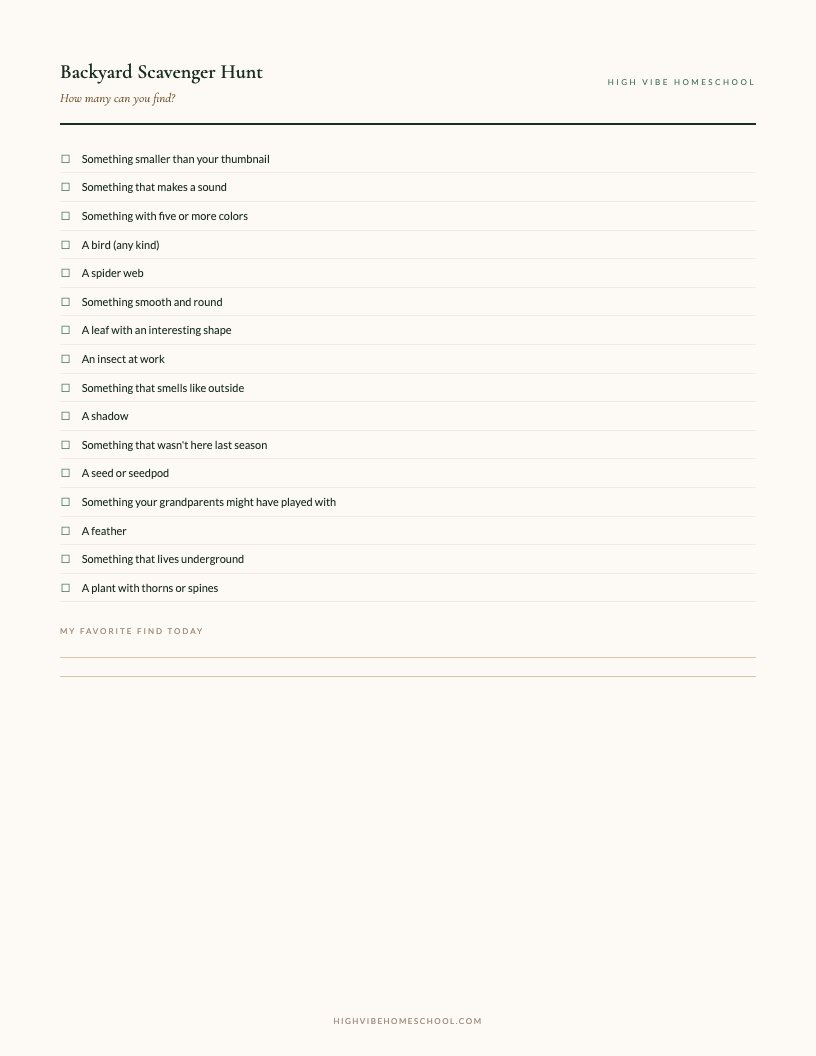
Nature Scavenger Hunt Pack
4 hunts for different settings: backyard, neighborhood, park, and a seasonal version for spring or fall.
No spam. Unsubscribe anytime.
For a complete science curriculum framework, Charlotte Mason nature study provides the philosophical backbone. And nature journaling for kids is how we document what we observe and discover.
Written by
The High Vibe Homeschool Team
We are a homeschool family that has been doing this for seven years across three kids. We write about what we have actually tried, what failed, what surprised us, and what we would do again. No credentials. Just lived experience.
ENJOYED THIS ARTICLE?
Get more like it every week
Real homeschool life, in your inbox.
Keep Reading
More in Curriculum
 Curriculum
Math Games That Make Numbers Come Alive (Even for the Kid Who Hates Math)
My son cried at math worksheets for two years. Then we found games. Here are the ones that changed everything — no flashcards required.
 Curriculum
Living Books: What They Are and How to Find Them
Charlotte Mason's term for books that feel alive. Here's what makes a book 'living,' why it matters, and a list of the ones that have done the most for our homeschool.
 Curriculum
Teaching Writing at Home (When You Don't Feel Like a Writing Teacher)
Writing is the subject most homeschool parents fear most. Here's how we finally made it work — and the approach that produces the most growth for the least friction.