Nature Study in Winter: Why the Cold Season Is the Best One
Most families do nature study in spring and summer and call it good. Here is why winter is actually the richest season for observation — and what to look for when everything appears to be dead.
We almost gave up on winter nature study.
It was cold. The children were reluctant. There was nothing to see, they said. Everything was dead.
Then we went outside anyway, and I watched my daughter spend twenty minutes studying the structure of a bare oak tree against the sky — the way the main branches divided, the pattern of smaller branches off those, the tracery of the smallest twigs. She had never looked at a tree that way before. The leaves had been in the way.
Winter nature study is not a lesser version of spring nature study. It is a different thing entirely.
What Winter Reveals
Bark. You cannot see bark when trees are leafed out. In winter, bark becomes the primary identifying feature. The rough diamond pattern of white ash. The shaggy, peeling strips of shagbark hickory. The smooth, gray-green of beech. The deep furrows of old oak. Children who spend a winter studying bark know trees in a way that summer naturalists never do.
Structure. Branch patterns, the angle of attachment to the main trunk, the overall silhouette of a tree — all invisible when foliage is present, all plainly visible in winter. My daughter can now identify six species of tree from a distance by silhouette alone.
Tracks. Snow is the best tracking medium available. A fresh snowfall and a quiet morning will show you everything that moved through your yard overnight: deer, rabbits, squirrels, cats, birds. Following a track is genuine detective work and produces completely absorbed children.
Lichen. Lichen is always there but rarely noticed until there is nothing else to notice. A hand lens and a winter morning will reveal a world. Lichen is actually two organisms — a fungus and an algae — living in a partnership that has existed for millions of years. That single fact has sent more children to the library than any planned lesson I have devised.
Seeds and pods. What the plant left behind. The milkweed pod split open, the seed tufts mostly gone. The dried coneflower heads still holding seeds. The hard round galls on oak stems where wasps overwintered. Seeds are the plant's bet on the future, and winter strips away everything except the bet.
What to Bring Outside
Preparation determines how long the observation session lasts and how much actually gets noticed.
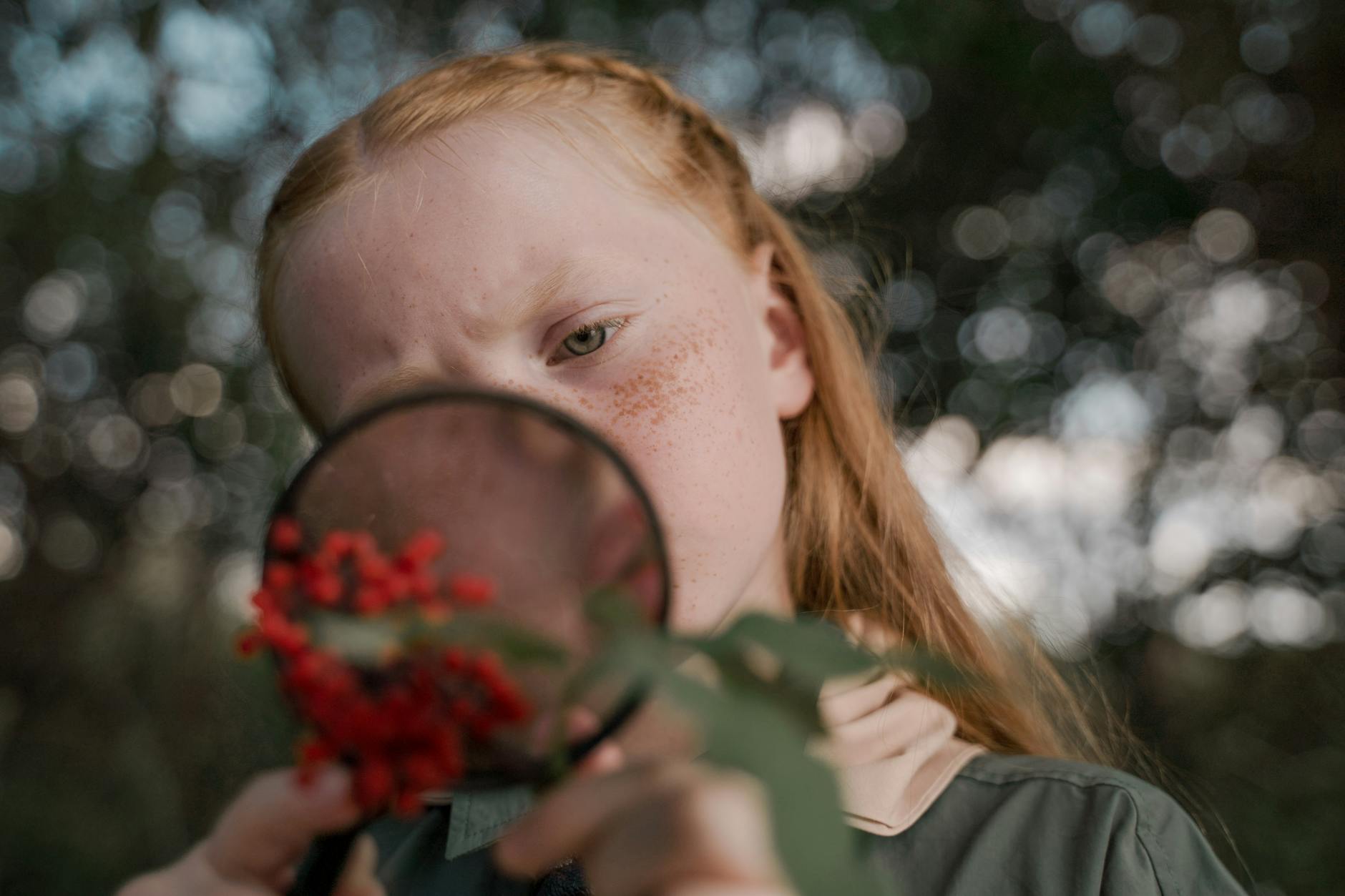
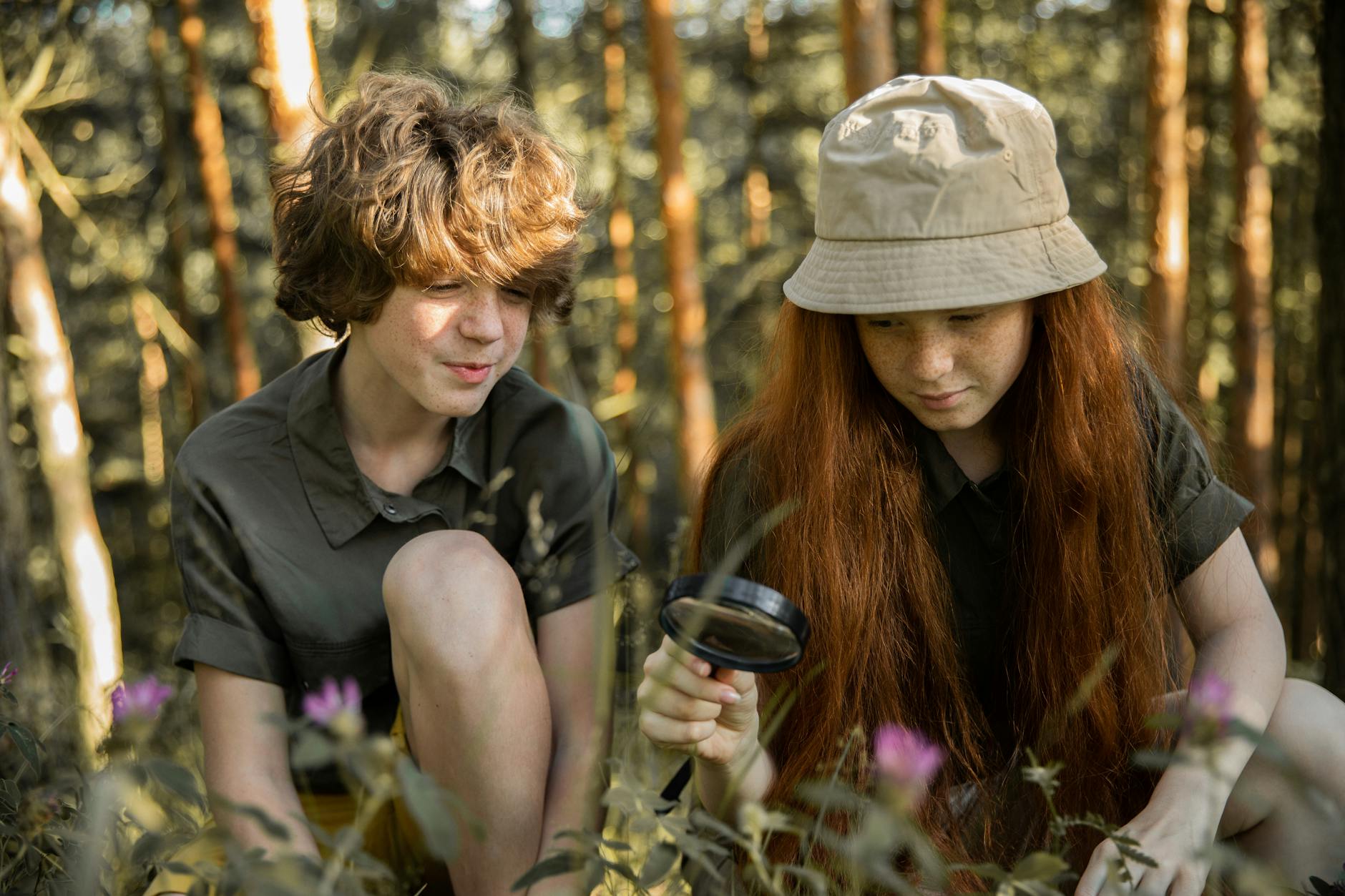
A hand lens (10x) is the single most valuable tool for winter observation. Children who have never used one will spend an extraordinary amount of time examining bark texture, the geometry of ice crystals on a leaf edge, the surface detail of a seed. A decent hand lens costs less than most activity books and produces more genuine science than most curricula.
A field guide to winter trees is worth having. Most standard tree guides include a winter identification section. The Peterson Field Guide to Trees of Eastern/Western North America has good winter sections. If your child is already interested in tracking, Olaus Murie's Field Guide to Animal Tracks is the classic and it is genuinely excellent.
A small sketchbook and a pencil. Pencils work in cold when pens freeze. The act of sketching what you observe produces different and deeper attention than photographing it. Both have their place, but sketching first teaches the child to look before they record.
A ruler or tape measure for tracks and galls. Size matters in identification. A track that is 3.5 inches wide is a different animal than one that is 1.5 inches wide, and measuring transforms a vague observation into a useful data point.
Making It Work in the Cold
The obstacle is clothing, not weather. Children who are warm stay outside indefinitely. Children who are cold last eight minutes.
Wool base layers. Waterproof outer layers. Wool socks that stay dry inside waterproof boots. Mittens rather than gloves for small hands. A thermos of something hot.
Once this is sorted, the cold becomes almost irrelevant. My children have done some of their best outdoor observations in temperatures below freezing, because the cold produces a particular quality of attention — quieter, slower, more careful — that warm weather does not.
One practical note: hand lenses and pencils can be hard to use with thick mittens. Some children do fine removing one mitten briefly for close observation and then replacing it. Others prefer thin liner gloves for observation sessions. Find what works for your child specifically, before a planned observation day rather than during it.
Starting the Observation When the Children Are Resistant
Most children who say there is nothing to see in winter have never been shown what to look for. The problem is not the season; it is the frame.
Start with something dramatic and specific. If you have had a fresh snowfall, go directly to the tracks. "Something walked through here last night — let's figure out what it was." This is a problem to solve, not a nature study to endure. Children respond to problems.
If there is no snow, start with something they can touch: a gall on an oak stem, a lichen cluster on a rock, a seed pod they can open. Something with immediate sensory interest. The conversation that follows from "what do you think made this lump?" is more engaging than "let's study nature."
Give the observation a specific goal. Not "let's look at trees" but "let's see if we can identify every kind of tree in the yard." A goal with a definite end makes the activity feel more purposeful, especially for children who struggle with open-ended observation.
The Winter Nature Journal
Winter journal entries are different from spring and summer entries. There are fewer things to draw and describe, which means each entry is more considered.
A single bark rubbing. A track sketch with measurements. A careful drawing of a lichen colony at several times its actual size, using a hand lens. A note about what the light looked like at 4 PM on a January afternoon.
These entries become some of the most interesting in the whole year's journal. The observation required to fill a page when not much is happening is deeper than the observation of a summer meadow full of competing attractions.
One specific practice that has worked well: the bark rubbing. Place a thin piece of paper against a section of bark and rub a pencil or crayon gently over it. The pattern of the bark transfers to the paper. Identify the tree, label the rubbing, date it. A collection of bark rubbings from six or eight trees in your area makes for a genuinely beautiful and scientifically useful reference page in the nature journal.
Winter Bird Watching
Birds are one of the most accessible forms of winter nature study because many species are present specifically in winter, more visible without foliage, and can be reliably brought closer with a feeder.
A basic seed feeder with black oil sunflower seeds will attract chickadees, nuthatches, finches, juncos, and in many areas woodpeckers, within a week or two. Children who observe a feeder regularly over a winter will begin to notice arrival and departure patterns, dominant individuals, the behavioral differences between species, and which seeds different birds prefer.
A good field guide specific to your region helps enormously. The Sibley Guide is the comprehensive standard. For children just starting, Sibley's Birds of Eastern or Western North America is a more manageable size. If budget is a concern, the free Merlin app from the Cornell Lab of Ornithology is excellent for identification and will identify birds by their calls.
The thing about feeder observation is that it can happen from inside, through a window. This is winter nature study that requires no cold-weather gear at all, which makes it a genuinely sustainable daily practice.
What Winter Nature Study Teaches
It teaches patience. The willingness to look at something slowly, for a long time, without expecting something dramatic to happen.
It teaches that nothing in nature is ever actually dead. The seeds are waiting. The insects are pupating. The bacteria are slowly breaking down the leaf litter. The trees are standing, the energy stored, ready for spring.
It teaches that what appears to be the absence of life is always just a different kind of life.
That is worth going outside for.
Free Download
Nature Journal Pages
5 illustrated pages for outdoor observation: drawing box, date, weather, and 'I wonder' prompts.
No spam. Unsubscribe anytime.
Nature study for beginners is the foundational piece. And nature journaling for kids covers how to document what you find — the practice that makes winter observations stick.
Written by
The High Vibe Homeschool Team
We are a homeschool family that has been doing this for seven years across three kids. We write about what we have actually tried, what failed, what surprised us, and what we would do again. No credentials. Just lived experience.
ENJOYED THIS ARTICLE?
Get more like it every week
Real homeschool life, in your inbox.
Keep Reading
More in Daily Life
 Daily Life
How to End the Homeschool Year Well
The end of the homeschool year deserves more than quietly stopping. Here is how we close out the year intentionally — what we review, what we celebrate, and how we rest well before the next one begins.
 Daily Life
Homeschool Summer: How to Rest Without Losing Everything You Built
Summer in a homeschool is not the same as summer vacation. Here is how we structure ours — enough rest to restore everyone, enough continuity to make September feel like a continuation rather than a restart.
 Daily Life
Outdoor Science: The Homeschool Advantage You're Not Using
Most science curricula are indoor, textbook-based affairs. The outdoor world offers something they cannot: real science, happening in real time, available every day.