Montessori at Home: The Principles That Work Without a Classroom
You do not need Montessori materials to use Montessori principles. Here is what Montessori education actually is, which parts translate beautifully to home, and what you can implement this week.
A little note: Some links in this post are affiliate links. If you click through and buy something, we earn a small commission at no extra cost to you. We only ever link to things we would genuinely recommend to a friend.
Maria Montessori developed her educational method in early-twentieth-century Rome, working with children who had been written off by the educational system of the time.
Her core observation was simple: children are naturally curious and capable of directing their own learning, given the right environment and the right freedom to pursue it. The elaborate Montessori materials, the multi-age classrooms, the three-hour uninterrupted work periods — all of it exists in service of that one observation.
You do not need the full Montessori apparatus to benefit from what she discovered.
The Core Principles Worth Knowing
Follow the child. Observe what the child is drawn to. Build the learning environment around those interests. Do not force an interest that is not there. Wait for the window when it opens.
Prepared environment. The child's physical environment should invite exploration and independent engagement. Materials should be accessible without adult help. Beauty and order matter. A chaotic, inaccessible environment produces passive, dependent children.
Sensitive periods. Montessori observed that children pass through windows of intense sensitivity to specific types of learning — language, order, movement, small details. Learning is most effortless when it happens inside these windows.
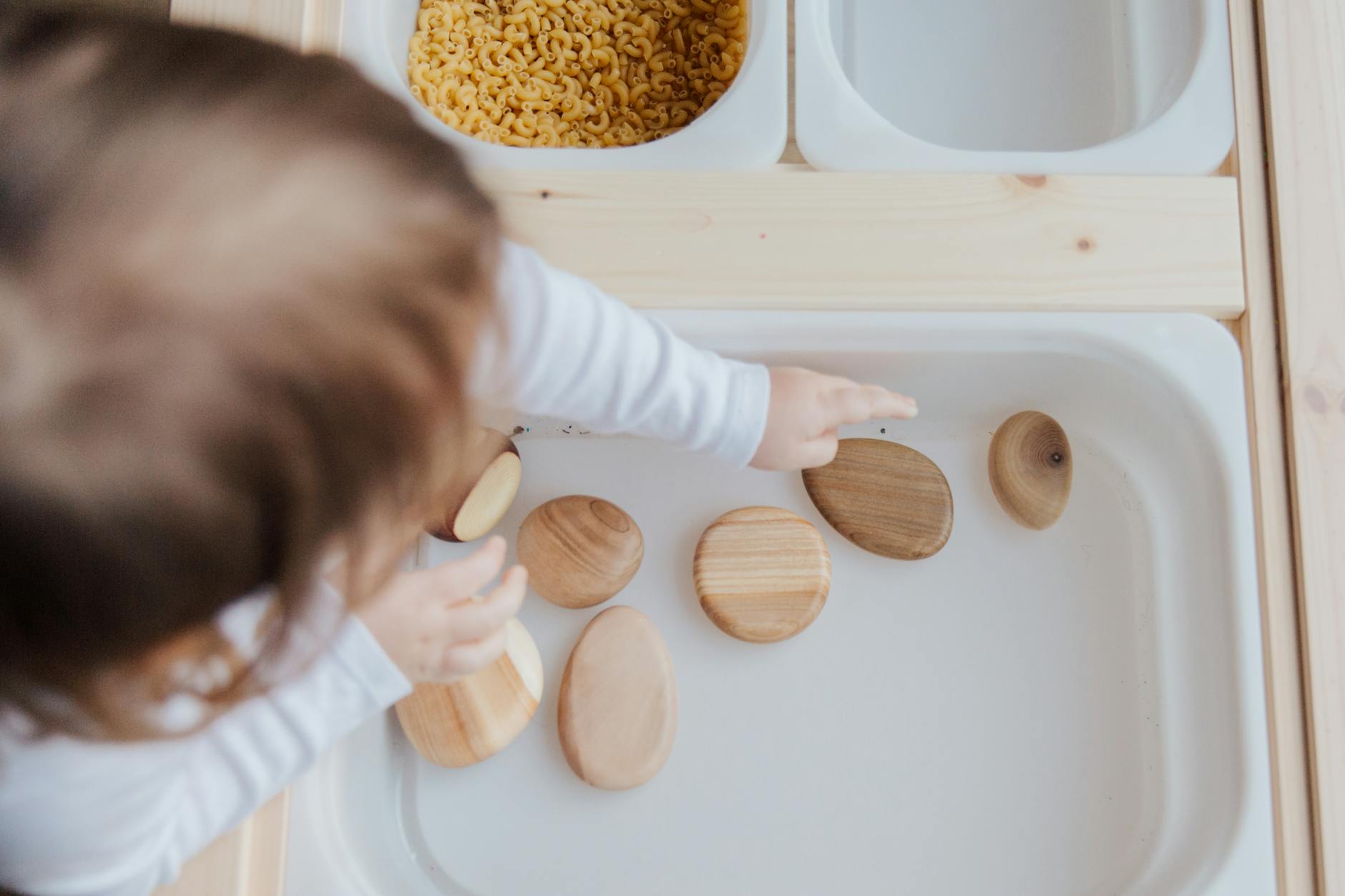
Work, not play. Montessori did not distinguish between work and play for children. Both are serious, concentrated engagement with the world. When a toddler carefully pours water from one container to another, this is not play in the dismissive sense. It is real work that produces real neural development.
Independence as the goal. The role of the adult is to help the child do things for themselves. "Help me do it myself" is the Montessori shorthand. Every lesson, material, and interaction should be moving the child toward greater independence.
What Translates Best to Home
A prepared reading space. Books at child height, spines visible, easily browsed. Not a wall of books in no particular order. A curated selection, changed regularly, displayed invitingly.
Real tools. Montessori homes give children real knives (child-safe), real glasses, real cleaning tools. The principle: fake tools for adults produce fake engagement. Real tools for real tasks produce real capability and real pride.
Practical life work. Cooking, cleaning, gardening, laundry. Montessori treats these as educational activities, not chores. Children who participate in running a household learn practical skills, independence, sequencing, and care for their environment. They are also genuinely useful, which matters to children more than adults often realize.
Uninterrupted work time. A block of time, ideally ninety minutes to three hours, where the child chooses their work and pursues it without interruption. This is harder than it sounds for parents who have been trained to direct learning. It is also one of the practices that produces the most observable depth of engagement.
Observation before intervention. Before stepping in to help or redirect, watch first. Is the child truly stuck, or are they working through difficulty in a way that is good for them? Montessori parents and teachers are trained to observe extensively before intervening. Most of us intervene too quickly.
A Practical Way to Start This Week
You do not need to buy anything or reorganize your whole home to begin using Montessori principles.
Start with one shelf. Pick one accessible shelf in your home and arrange it this week with materials your child can reach, use, and return independently. It might be art supplies arranged in small trays. It might be three books displayed face-out. It might be a small tray with a pouring activity for a toddler.
The point is not the shelf itself. The point is the experience of a child going to a place, choosing something, working with it, and returning it without asking for permission or help. That experience is what Montessori is building toward.
Once you have one shelf working, watch what happens. Does your child use it? What do they choose? What do they ignore? The answers tell you what to add, what to remove, and what to rotate in next month.
The Materials: Worth Buying vs. Not Worth It
Montessori materials are beautiful and extremely well-designed. They are also very expensive. For most homeschool families, a selective approach is more realistic than trying to replicate a full Montessori classroom.
Worth buying:
Sandpaper letters. For early phonics work. The multisensory element (tracing with fingers while saying the sound) produces better retention than visual-only letter learning.
A moveable alphabet. Wooden or plastic letters used for early word-building before the child can write. One of the most useful early literacy tools we have owned.
Number rods or counting beads. For building number sense in early childhood. The physical, concrete representation of quantity is more powerful than numerals alone.
Not worth buying for most families:
The full Montessori geography materials, most of the binomial and trinomial cubes (beautiful, very expensive, limited educational shelf life), and the complete sets of sensorial materials. These are designed for classroom environments with many children cycling through them. At home, most children will use them briefly and move on.
Montessori and the Older Child
Most Montessori conversation focuses on ages two through six. But the principles extend well beyond early childhood.
The middle school Montessori program, called Erdkinder, moves children into real-world projects and work as the primary learning mode. Growing food, running a small business, participating in the community. The principle is the same: genuine work that matters, chosen by the child, with a real result.
You cannot replicate Erdkinder at home exactly, but the spirit of it is accessible. Give a ten-year-old a real project with real stakes. Let a twelve-year-old take responsibility for something that genuinely matters: the family garden, a small business, a cooking assignment for the whole family three nights a week. Real responsibility produces learning that no worksheet can replicate.
The older the child, the more Montessori looks less like specific materials and more like the question: what real work is this child doing? Not simulated work. Not workbooks. Real things with real outcomes.
Common Questions About Montessori at Home
Does it work for children who are not naturally self-directed? Yes, with adjustments. Some children need more scaffolding to choose and sustain work independently. You can offer choices within a structure rather than fully open choice. "Would you like to work with the beads or the alphabet?" is still Montessori-aligned and works better for children who are overwhelmed by unlimited options.
Can I combine Montessori with another curriculum? Yes. Many families use Montessori principles for environment, practical life, and early literacy while using a different approach for math or history. The principles are not a closed system. They coexist with Charlotte Mason, classical approaches, and unschooling more naturally than they do with heavy worksheet-based curricula.
My child just wants to play. Is that okay? Montessori would say yes, with the caveat that play and work are the same thing for young children. If a four-year-old is deeply engaged in sorting pebbles by color, that is work. Do not interrupt it. The question to ask is not "are they playing" but "are they deeply engaged?" Deep engagement is the sign you are looking for.
The Honest Limitation
Montessori is most powerful in its complete form, with trained teachers, multi-age groupings, and the full prepared environment. Taking pieces of it and applying them in a conventional homeschool setting produces real benefits, but it is not the same as Montessori education.
That is not a reason not to use the pieces that work. The principles of following the child, preparing the environment, and moving toward independence are universally applicable. They make homeschooling better regardless of what curriculum or approach you use alongside them.
The core question is always the same: am I doing this because it serves the child's development, or because it makes me feel like I am doing school? The best homeschooling, Montessori-influenced or not, keeps asking that question.
Montessori and Charlotte Mason share a deep respect for the child's natural development — both are worth understanding even if you follow neither completely. And practical life work is the Montessori-aligned practice that produces the most visible real-world skills.
Written by
The High Vibe Homeschool Team
We are a homeschool family that has been doing this for seven years across three kids. We write about what we have actually tried, what failed, what surprised us, and what we would do again. No credentials. Just lived experience.
ENJOYED THIS ARTICLE?
Get more like it every week
Real homeschool life, in your inbox.
Keep Reading
More in Curriculum
 Curriculum
Math Games That Make Numbers Come Alive (Even for the Kid Who Hates Math)
My son cried at math worksheets for two years. Then we found games. Here are the ones that changed everything — no flashcards required.
 Curriculum
Living Books: What They Are and How to Find Them
Charlotte Mason's term for books that feel alive. Here's what makes a book 'living,' why it matters, and a list of the ones that have done the most for our homeschool.
 Curriculum
Teaching Writing at Home (When You Don't Feel Like a Writing Teacher)
Writing is the subject most homeschool parents fear most. Here's how we finally made it work — and the approach that produces the most growth for the least friction.