
Homeschool Record Keeping: The Simplest System That Actually Works
Records are either simple and consistent or they are not. Here is the system we have used for five years that takes less than ten minutes per day and has everything we need when we need it.
Here is the truth about homeschool record keeping: if the system is complicated, you will not do it.
You will do it in September, when the motivation is high. You will partially do it in October and November. By December it will be a pile of loose papers and good intentions.
The system I am going to describe is genuinely simple. It produces complete, usable records without requiring more than ten minutes a day. It has held up across five years of homeschooling, a high-regulation state review, two cross-country moves, and three very different children.
What Records You Actually Need
For most families in most states: A basic attendance record and a list of subjects covered. That is the legal minimum in low-to-moderate regulation states.
For portfolio review states: Samples of work across core subjects, dated, from across the year. The emphasis is on demonstrating progress, not perfection.
For high school transcripts: Course names, credit hours, grades, and a brief course description.
For your own sanity: A record you can look back at to see what you covered and how the year went.
Notice what is not on this list: elaborate lesson plans, daily learning logs, or documentation of every single thing your child did. These are often what anxious new homeschoolers create and then abandon.
Know Your State's Requirements First
Before you build any system, spend thirty minutes looking up your state's specific requirements. They vary significantly.
Some states require almost nothing. You notify once, you school, you file no ongoing documentation. Other states require quarterly assessments or annual portfolio reviews with a certified teacher. A few require test scores.
The Home School Legal Defense Association (HSLDA) maintains a state-by-state map that is reasonably up to date. Your state's homeschool organization will have more specific guidance and sometimes template forms.
If you are in a low-regulation state and you are maintaining documentation beyond what is legally required, you are doing it for yourself and your records, not for the state. That is fine. Just know the difference so the obligation feels accurate.
The System: Three Things
A simple planner or notebook. One page per week. I write down what we actually did, not what I planned. Takes two to three minutes at the end of each school day.
I note: books read aloud, subjects covered, any projects or activities, field trips, notable conversations. This is not a lesson plan. It is a brief record of the actual day.
A photography habit. Every project, experiment, artwork, and notable piece of work gets photographed with my phone. I have a folder per child per year. These are the work samples.
A book log. A simple list of every book read, finished, or abandoned by each child, with the date finished. This single document has been the most useful record I keep.
What the Weekly Notebook Looks Like in Practice
I use a simple spiral notebook, one per child per year. At the top of each Monday's page I write the week of the year (Week 14, for example). Each day I write three to five lines: what math program we were on and what we finished, what read-alouds happened, what subjects we covered.
Monday, Week 14: Math-U-See Gamma, Lesson 12. Read aloud: two chapters of The One and Only Ivan. Copywork + handwriting. Nature walk, identified three bird species.
That is it. Two minutes. Dated. Filed in the notebook.
At the end of the year, I can flip through and account for every week of school. I can see when we took breaks, what we were covering in February, when we started the history unit. The record is complete without being burdensome.
The Photography Habit
This is the record that surprises people when they look back.
My phone has a folder for each child labeled by year. Any time a child finishes a project, creates something, does an experiment, or produces work I want to keep, I photograph it. The project then goes wherever it goes. The photo is the record.
At year end, I have hundreds of photos of actual work. This has been useful for portfolio reviews, for showing the year to family members, and for the children themselves, who love scrolling through what they did.
The photography takes almost no additional time because you are photographing something anyway. The habit is just to do it consistently.
The Annual Review Moment
At the end of each year, I spend about an hour creating a one-to-two page summary of the year for each child. It covers:
- Subjects studied and approximate hours
- Books read (pulled from the book log)
- Projects completed
- Outside activities (co-op, sports, music, etc.)
- What worked, what we dropped, what we want to do more of
This summary is the record that actually gets used. If someone asks what we covered this year, I hand them the summary. If we ever need to enroll a child in school, the summary documents their learning. If we apply to a co-op or program, the summary supports the application.
The summary takes an hour to create because the weekly notebook and book log make all the information easy to pull together.
What Counts as a Subject
New homeschoolers often struggle with what to log as subjects versus what is just life.
If it was intentional and educational, it counts. A day at a living history museum counts as history. An afternoon baking bread counts as home economics and can count as science if you discuss the yeast. A child who spent three hours building an elaborate block structure and explaining the engineering to a parent has done engineering.
The anxiety is usually about whether logging "real" subjects will leave a gap somewhere. It will not, if you are providing a broad education. What creates gaps is not recording them too broadly. What creates gaps is actually not covering them.
Log what you actually did. If the record looks thin in a subject area, that is information about your homeschool, not a problem with your logging.
The Digital Option
Some families do their record keeping entirely digitally and love it. Google Drive, Notion, or simple spreadsheets work well.
The risk is that digital record keeping is easier to abandon or lose access to. A physical notebook does not get deleted, synced to the wrong version, or locked out when a subscription lapses.
If you prefer digital, keep a backup. Print a copy of your records each summer and put it somewhere physical.
We tried a digital system in year two. It was beautiful and elaborate. I stopped updating it in November. The physical notebook has been consistent for three years.
One Thing That Helps More Than Any System
Teach your children to narrate.
A child who can tell you what they read, what they learned, and what they are thinking about provides you with real-time assessment of their progress without any formal testing. Narration is both an educational practice and a record-keeping shortcut.
When my children narrate well, I know what they understand. I can note it briefly and move on. When they struggle to narrate, I know something needs more time. The record reflects the learning because the learning was real.
That is the whole point of records, finally: not to document compliance, but to track genuine growth. A simple system used consistently tells you more about your child's learning year than an elaborate system abandoned in October.
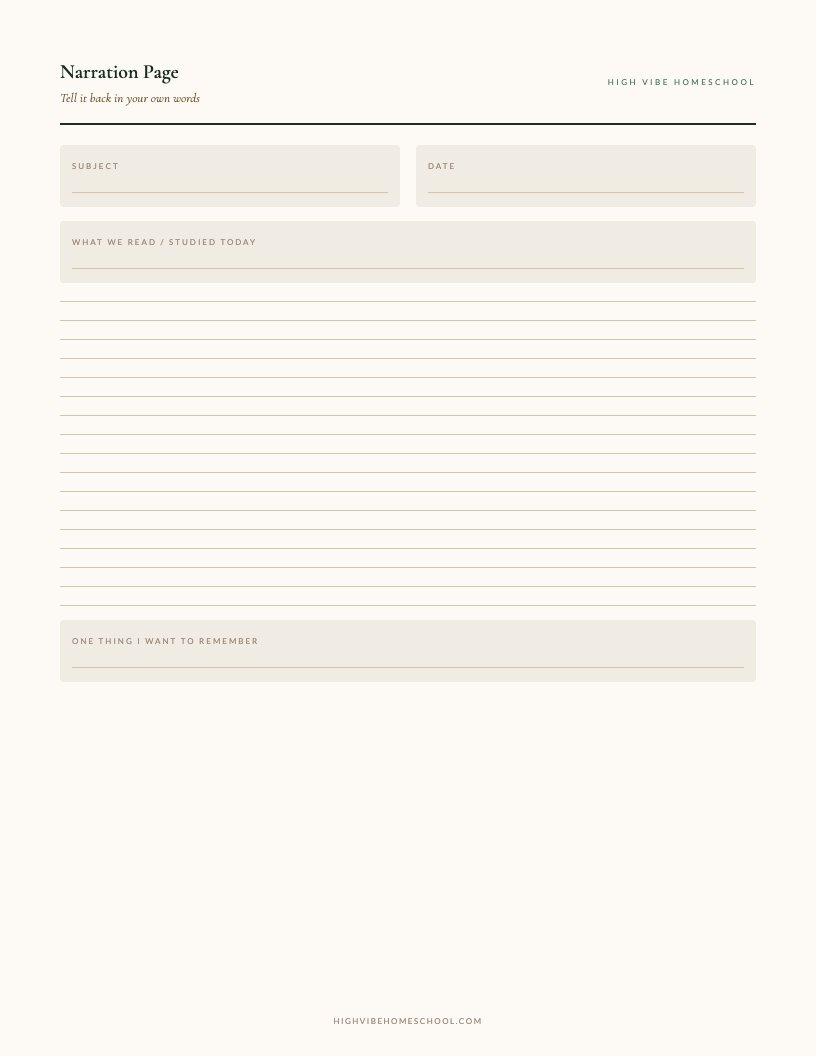
Free Download
Charlotte Mason Notebooking Pages
4 pages for recording what your child is learning: lined narration, drawing box, nature entry, and free study.
No spam. Unsubscribe anytime.
The record is only as useful as what it reflects. Homeschool portfolios covers how to select and organize the best evidence from your records. And for families approaching high school, creating a transcript shows how records become official documentation.
Written by
The High Vibe Homeschool Team
We are a homeschool family that has been doing this for seven years across three kids. We write about what we have actually tried, what failed, what surprised us, and what we would do again. No credentials. Just lived experience.
ENJOYED THIS ARTICLE?
Get more like it every week
Real homeschool life, in your inbox.
Keep Reading
More in Getting Started
 Getting Started
Homeschool Portfolios: What They Are and How to Build One That Works
A portfolio is more than a legal requirement. When done right, it becomes the most useful thing in your homeschool — a record of real growth that no standardized test can capture.
 Getting Started
What Grade Is My Homeschooled Child In?
When people ask what grade your homeschooled child is in, the honest answer is often complicated. Here is how to think about grades, what they actually matter for, and what you can say.
 Getting Started
Deschooling: What It Is and Why You Should Not Skip It
Every family that pulls their child out of school needs a period of deschooling first. Most skip it. Here's why that's a mistake and what it actually looks like.