
Homeschool Portfolios: What They Are and How to Build One That Works
A portfolio is more than a legal requirement. When done right, it becomes the most useful thing in your homeschool — a record of real growth that no standardized test can capture.
I started keeping a portfolio because my state required one.
I kept going because it changed how I saw my children's progress.
By December of our first year, I could flip back through eight months of my daughter's writing samples and see something I had not noticed while it was happening: her sentences had gone from short and halting to varied and confident. She was reaching for new words. She was organizing paragraphs.
A test would have told me a score. The portfolio told me a story.
What a Homeschool Portfolio Is
A portfolio is a collected sample of your child's work over time. It is not a grade book, a transcript, or a daily log. It is evidence of learning, selected and organized to show growth and depth.
Depending on your state, a portfolio might be:
Required for legal compliance. Some states require an annual review of a portfolio by a certified teacher or a notarized assessment. Check your state's homeschool law specifically, since requirements vary widely.
Voluntary but useful. Even where portfolios are not required, many families keep them as a way to track progress, prepare for high school transcripts, or apply to co-ops or programs.
A record for the child. At the end of each year, handing a child their portfolio can be one of the most meaningful moments in your homeschool. This is the year you had. Look at what you made.
What Goes In It
This is where most people overthink. You do not need everything. You need representative samples.
Writing: Three to five pieces per quarter, ideally including early drafts and final versions. You want to see development, not just finished work.
Math: Occasional work samples showing computation and problem-solving. A page of math facts practice tells you less than a word problem the child worked through independently.
Reading log: A simple list of books read, or a few sentences the child narrated about each book.
Projects: Photos. Most projects get dismantled, built over, or repurposed. Photograph them before they disappear.
Nature journal entries and drawings.
One or two pieces the child selected themselves. Let them choose something they are proud of each quarter. This is often more revealing than anything you would choose.
How We Organize Ours
We use one three-inch binder per child per year, with tabbed sections by subject. Each section has a simple sheet at the front listing what is included and why it was chosen.
At the end of each month, I take fifteen minutes to pull anything that represents a milestone or meaningful piece of work, date it, and file it.
That fifteen minutes has, over three years, produced archives I would not trade for anything.
If you want a more formal system, the above is well-organized with pre-printed dividers and an evaluation section. We use simpler binders, but the structure is similar.
The Photography Workflow
Projects, nature study, experiments, field trips, art projects. Nothing goes undocumented.
I have a folder on my phone for each child, and after anything interesting happens, I move a photo into it. At the end of each month, I print six to eight of the best ones at a drugstore (about four dollars) and slide them into page protectors in the portfolio.
Future you will be grateful. Children love looking back at the year, and photos make it real in a way no written description can match.
Portfolio Review: Making It Meaningful
At the end of each year, we do a portfolio review that takes about an hour per child. We sit together, go through the whole binder, and talk about each section.
I ask three questions:
- What are you most proud of this year?
- What was hardest?
- What do you want to get better at next year?
Their answers always surprise me, and they always tell me something about the year I did not know I had missed.
The review is also when I decide what to keep and what to archive. Not everything from the current portfolio needs to follow us into the next year. Some of it gets transferred to a long-term archive box. Some of it gets sent home to grandparents. Some of it gets ceremonially placed in a recycling bin by the child who made it, which is also educational.
A Note for Families in Regulated States
If your state requires a portfolio review, find out the specifics before you start building. Some states want a portfolio reviewed by a credentialed evaluator in person. Others accept written assessments. Others accept the portfolio as documentation submitted with an annual notice.
The Homeschool Legal Defense Association maintains a state-by-state legal guide. It is worth fifteen minutes to understand what is actually required before you spend a year building a portfolio that does not meet the right standard.
What Makes a Portfolio Useful vs. Just Compliant
There is a version of portfolio-keeping that is purely defensive. You file enough work to satisfy a reviewer and nothing more. It takes twenty minutes a year and produces a document that proves nothing except that school happened.
That is not what I am describing.
The portfolio that actually benefits your homeschool is one that you use for your own reflection, not just for external review. The question to ask yourself when filing a piece of work is not "will a reviewer accept this?" but "does this tell me something true about where this child is right now?"
A strong portfolio contains:
Work that shows what the child can do at their best, alongside work that shows what they are still working on. Both matter.
Evidence of interests and passions, not just academic subjects. A child who spent six weeks building an elaborate model city has produced something real. Photographs of it belong in the portfolio.
Samples from the beginning, middle, and end of the year. If all your writing samples are from May and June, you cannot see the growth.
The child's own voice, through narrations they wrote, books they chose, projects they initiated.
The Digital Portfolio Option
Paper binders work well. They are also not the only option.
Some families keep digital portfolios using a simple folder structure on a shared drive. Each child has a folder, with subfolders by subject and month. Scanned or photographed samples go in. At the end of the year, a selection gets printed or compiled into a PDF.
The advantage of digital: you can include audio (a child reading aloud at the beginning and end of the year) and video (a science experiment, a math concept explained on a whiteboard, a nature walk narration).
The disadvantage: it requires more discipline to actually maintain. A binder on the shelf that you add to monthly is more likely to get done consistently than a digital system that requires uploading and organizing.
Use whichever format you will actually maintain. An incomplete paper binder beats a perfect digital system that never got set up.
What the Portfolio Shows You That Testing Cannot
At the end of year three of our homeschool, I had a portfolio review with my son that included a writing sample from September of year one.
He could not believe he had written it. He had no memory of being that writer. He looked at it for a long time and then said, "I've gotten better."
Yes. That is the point.
A standardized test score at age eight tells you where your child ranks relative to other eight-year-olds on a particular set of skills on a particular day. It tells you nothing about who they were six months ago and who they are becoming.
The portfolio holds the becoming. That is what it is for.
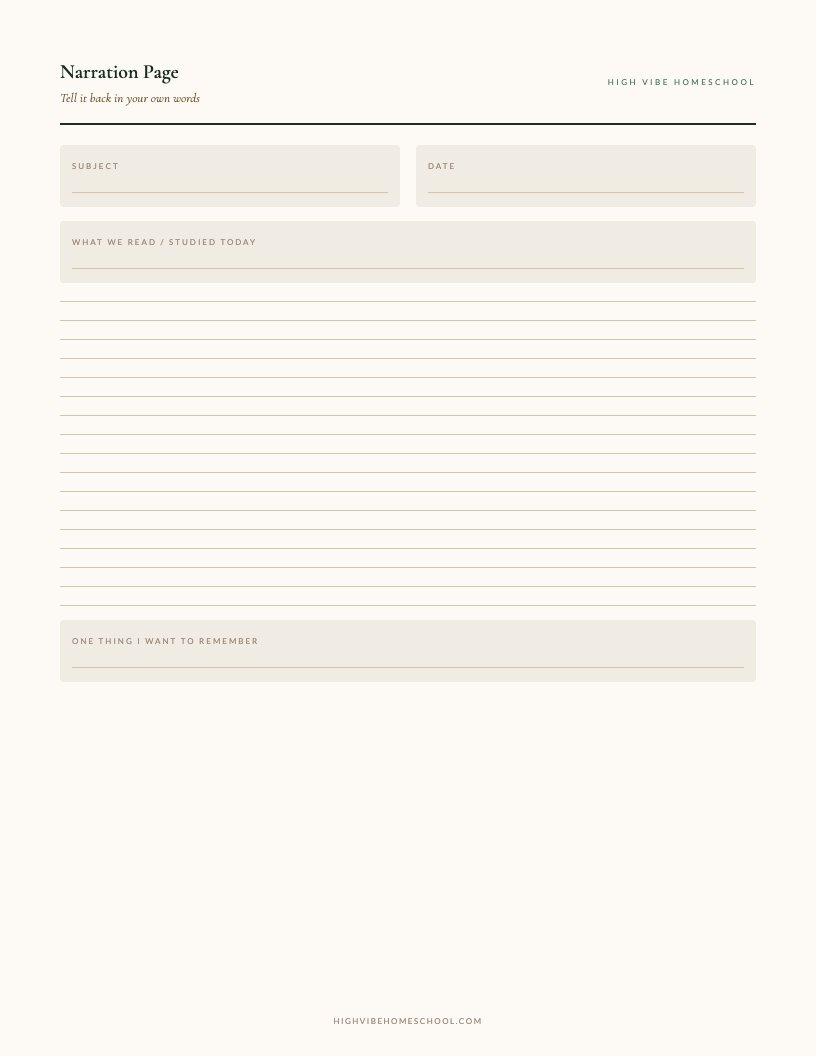
Free Download
Charlotte Mason Notebooking Pages
4 pages for recording what your child is learning: lined narration, drawing box, nature entry, and free study.
No spam. Unsubscribe anytime.
The portfolio and the record-keeping system work together — the records are the raw material the portfolio is made from. And homeschool high school transcripts covers how records become formal documentation for college.
Written by
The High Vibe Homeschool Team
We are a homeschool family that has been doing this for seven years across three kids. We write about what we have actually tried, what failed, what surprised us, and what we would do again. No credentials. Just lived experience.
ENJOYED THIS ARTICLE?
Get more like it every week
Real homeschool life, in your inbox.
Keep Reading
More in Getting Started
 Getting Started
What Grade Is My Homeschooled Child In?
When people ask what grade your homeschooled child is in, the honest answer is often complicated. Here is how to think about grades, what they actually matter for, and what you can say.
 Getting Started
Deschooling: What It Is and Why You Should Not Skip It
Every family that pulls their child out of school needs a period of deschooling first. Most skip it. Here's why that's a mistake and what it actually looks like.
 Getting Started
The Complete Guide to Homeschool Transcripts
Creating a high school transcript is one of the most important practical tasks in homeschooling. Here is everything you need to know — from what to include to how to calculate GPA.