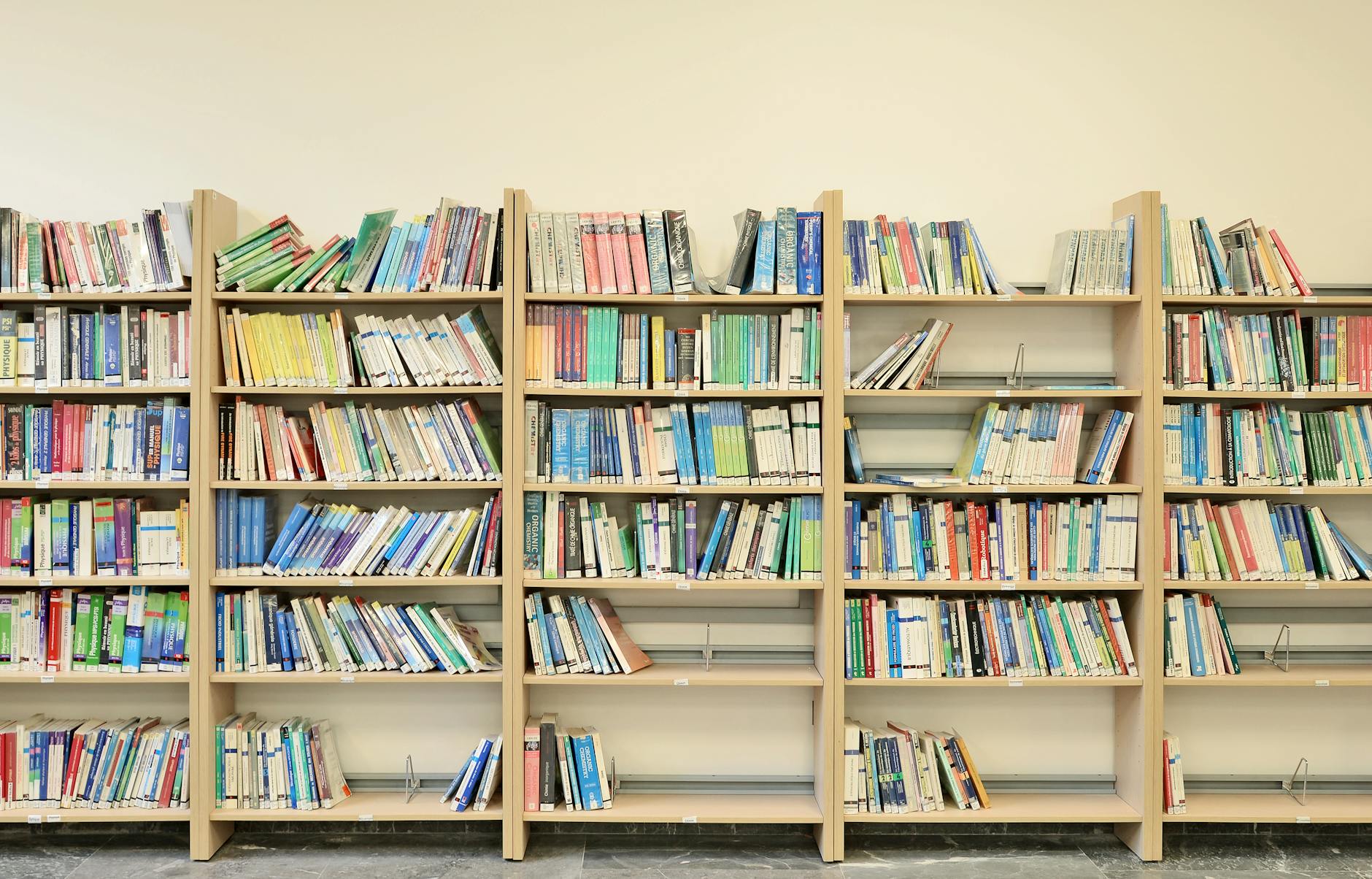
The High Vibe Homeschool Reading List: 50 Books Across All Ages
A curated reading list of 50 living books for homeschool families — organized by age range and subject, with brief notes on what makes each one worth the time.
A little note: Some links in this post are affiliate links. If you click through and buy something, we earn a small commission at no extra cost to you. We only ever link to things we would genuinely recommend to a friend.
This is not a comprehensive list. It is the list of books that have produced real engagement, genuine learning, and lasting memory in our homeschool and the homeschools of families we know.
All of them qualify as living books in the Charlotte Mason sense: written by a person with genuine knowledge and love of the subject, in language worth reading aloud.
Read-Alouds for the Whole Family
Picture Books (All Ages)
- The Story of Ferdinand — Munro Leaf. A bull who would rather smell flowers. Still perfect.
- Make Way for Ducklings — Robert McCloskey. Boston geography and parental devotion.
- The Story About Ping — Marjorie Flack. One of the best books ever written for young children.
- Ox-Cart Man — Donald Hall. A year in a New England farm family's life.
- When You Reach Me — Rebecca Stead. For older children, a mystery that rewards rereading.
Early Chapter Books (Ages 5-9)
- My Father's Dragon — Ruth Stiles Gannett. The first in a trilogy, all of them excellent.
- The Boxcar Children — Gertrude Chandler Warner. Children living independently in a boxcar.
- Little House in the Big Woods — Laura Ingalls Wilder. Start here, not with Prairie.
- The Cricket in Times Square — George Selden. A cricket from Connecticut in a New York City newsstand.
- Rabbit Hill — Robert Lawson. Animals observe new humans moving to the farm.
Middle Chapter Books (Ages 8-12)
- The Phantom Tollbooth — Norton Juster. A love letter to curiosity and language.
- A Wrinkle in Time — Madeleine L'Engle. Still holds up. Read it with them.
- The Witch of Blackbird Pond — Elizabeth George Speare. Puritan New England, lived from inside.
- The Bronze Bow — Elizabeth George Speare. Roman-era Palestine, beautifully researched.
- Island of the Blue Dolphins — Scott O'Dell. Survival and solitude on an island off California.
- Roll of Thunder, Hear My Cry — Mildred Taylor. Mississippi, 1933. Unforgettable.
- Number the Stars — Lois Lowry. Denmark, 1943. The best World War II novel for this age.
Older (Ages 12+)
- The Lord of the Flies — William Golding. Worth reading and discussing carefully.
- To Kill a Mockingbird — Harper Lee. Alabama, 1930s. One of the great American novels.
- A Tree Grows in Brooklyn — Betty Smith. Coming of age in early-twentieth-century New York.
- My Antonia — Willa Cather. Nebraska, 1880s. One of the best books about place ever written.
History
Ancient and Medieval
- The Children's Homer — Padraic Colum. Retelling of The Iliad and The Odyssey.
- The Eagle of the Ninth — Rosemary Sutcliff. Roman Britain.
- The Door in the Wall — Marguerite de Angeli. Medieval England, plague, disability.
- Adam of the Road — Elizabeth Janet Gray. A minstrel boy in thirteenth-century England.
American History
- Johnny Tremain — Esther Forbes. Paul Revere's silversmith apprentice in Revolutionary Boston.
- Rifles for Watie — Harold Keith. The Civil War from both sides.
- Across Five Aprils — Irene Hunt. A family in Illinois through the Civil War.
- The Witch of Blackbird Pond — (listed above)
World History
- Number the Stars — (listed above)
- The Endless Steppe — Esther Hautzig. A Jewish girl exiled to Siberia in World War II.
- Friedrich — Hans Peter Richter. Nazi Germany through a Jewish boy's story.
- The Hiding Place — Corrie ten Boom. True story of hiding Jews in wartime Holland.
Science and Nature
- The Diary of an Early American Boy — Eric Sloane. Tools, skills, and daily life in 1805.
- Paddle-to-the-Sea — Holling C. Holling. A carved canoe travels from the Great Lakes to the Atlantic.
- Minn of the Mississippi — Holling C. Holling. A snapping turtle's journey down the Mississippi.
- The Outermost House — Henry Beston. A year alone on the outer Cape Cod shore.
- A Sand County Almanac — Aldo Leopold. For older readers; one of the foundational environmental texts.
- The Incredible Journey — Sheila Burnford. Two dogs and a cat travel across Canada.
Science Living Books for Children
- Wild Animals I Have Known — Ernest Thompson Seton. True animal stories with moral seriousness.
- Stickleback Cycle — Carla Stevens. The life cycle of a fish, genuinely beautiful.
Books About Books and Learning
- The Read-Aloud Handbook — Jim Trelease. The best argument for reading aloud. Every homeschool parent should read it.
- For the Children's Sake — Susan Schaeffer Macaulay. Charlotte Mason's philosophy for modern families.
- How Children Learn — John Holt. Quiet, careful observations of children learning.
- The Well-Trained Mind — Susan Wise Bauer. The classical homeschool framework.
Using This List
Use the library first. Request books that are out of your branch's collection through interlibrary loan. Most items on this list are available free.
Purchase the ones you finish and want to own. After reading a book aloud together, if everyone wants to come back to it, it has earned shelf space.
Let your children add to the list. Their choices are as important as yours.
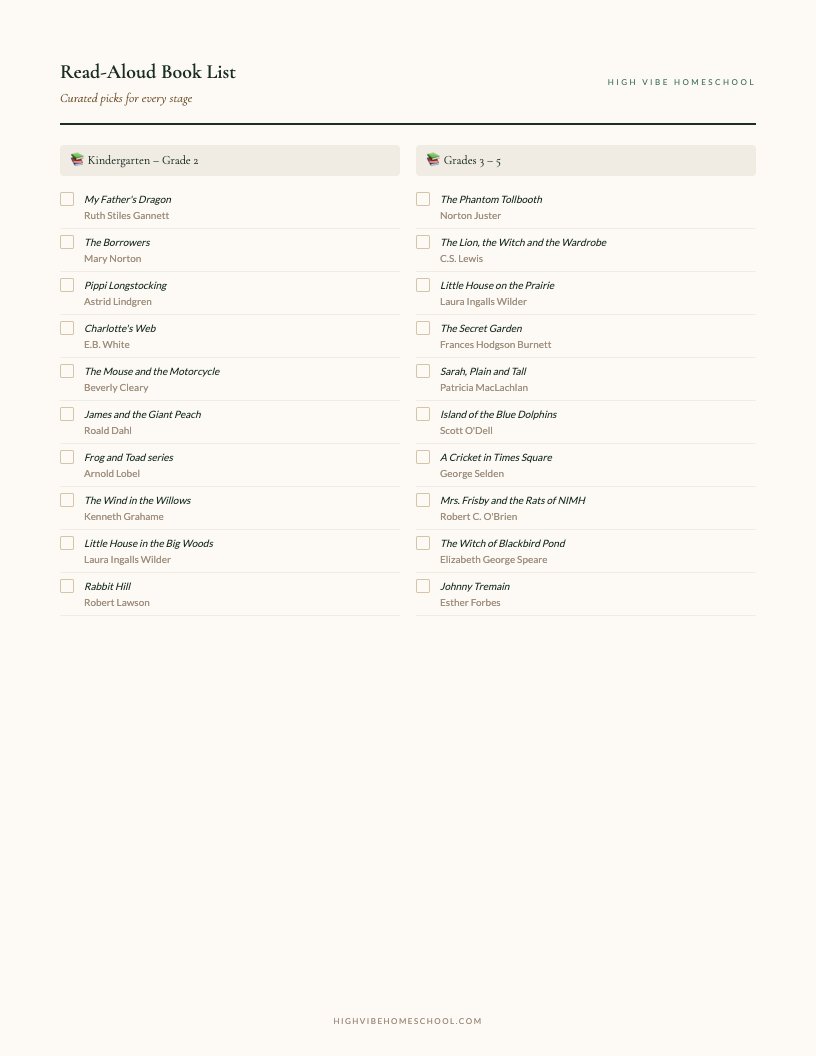
Free Download
Read-Aloud Book List by Age
Curated read-aloud picks for every stage: K-2, 3-5, and 6-8. Print and check them off as you go.
No spam. Unsubscribe anytime.
For the books that changed how we think about homeschooling as parents, 10 books every homeschool mom should read is the companion list. And audiobooks in our homeschool covers why listening counts — and how to access most of this list for free.
Written by
The High Vibe Homeschool Team
We are a homeschool family that has been doing this for seven years across three kids. We write about what we have actually tried, what failed, what surprised us, and what we would do again. No credentials. Just lived experience.
ENJOYED THIS ARTICLE?
Get more like it every week
Real homeschool life, in your inbox.
Keep Reading
More in Resources
 Resources
Our Favorite Read-Alouds for Every Age (That the Whole Family Actually Loves)
Read-alouds are the heartbeat of our homeschool day. Here are the books that made our kids beg us to keep reading — sorted by age so you can find your next one fast.
 Resources
Yes, Audiobooks Count. Here's How We Use Them.
Audiobooks are not a shortcut or a lazy day substitute. In our homeschool, they are a core tool. Here's exactly how we use them and why listening absolutely counts as reading.
 Resources
10 Books Every Homeschool Mom Should Read (At Least Once)
Not books for your children. Books for you. The ones that changed how we think about education, restored our confidence on the hard days, and gave us the words for what we were trying to do.