
Homeschool Language Arts: Building Real Writers and Readers
Language arts is the subject most homeschool parents overthink. Here is the simple framework we use — and why the components that actually produce writers and readers are not the ones most curricula emphasize.
A little note: Some links in this post are affiliate links. If you click through and buy something, we earn a small commission at no extra cost to you. We only ever link to things we would genuinely recommend to a friend.
Language arts is the subject most homeschool parents either over-complicate or under-attend.
Over-complication looks like: a separate curriculum for phonics, another for grammar, another for writing, another for spelling, another for vocabulary, another for literature. Five or six workbooks, each requiring daily instruction, for a single subject area.
Under-attention looks like: reading aloud a lot, doing some copywork occasionally, calling it good.
Neither produces what most of us actually want: children who can read deeply, write clearly, and use language precisely.
Here is what we have found actually produces those outcomes.
The Five Components
Language arts, broken down honestly, consists of five components. Not all of them need formal curriculum.
1. Decoding (Phonics)
The mechanical skill of turning letters into sounds. This requires systematic, explicit instruction for most children. It is the component most likely to need a real curriculum, at least through the early years.
Once a child is a fluent decoder — reading chapter books easily by around age eight or nine — phonics instruction is complete. You do not continue phonics after fluency.
2. Reading Comprehension
The ability to understand, remember, and draw meaning from text. This is built primarily through wide reading and narration — not through comprehension worksheets.
A child who reads broadly and narrates what they have read is building reading comprehension more effectively than a child doing "read the passage, answer five questions" exercises.
3. Handwriting and Mechanics
The physical skills of writing: letter formation, grip, spacing, punctuation, capitalization. These require direct instruction and daily practice in the early years, then maintenance.
Handwriting Without Tears is the most widely recommended handwriting curriculum for homeschoolers, particularly for children who find writing physically difficult.
4. Composition
The skill of putting thoughts into written form. This develops slowly and requires years of practice in this sequence: oral narration first, written narration second, structured paragraphs third, longer essays fourth.
Rushing any step in this sequence produces frustrated children and thin writing. Spending adequate time at each step — even when it feels slow — produces writers.
5. Grammar and Mechanics
The formal study of how language works: parts of speech, sentence structure, punctuation rules. Most homeschool families overemphasize this and underemphasize composition.
Grammar knowledge does not transfer directly to writing quality. Writers learn grammar through reading good prose and through editing their own work — not primarily through diagramming sentences.
A grammar reference used to answer specific questions as they arise is more valuable than a grammar curriculum for most children.
What the Research Shows
Reading researchers consistently find that the best predictors of strong literacy are:
- Phonemic awareness and phonics instruction in early childhood
- Volume of reading (how many books, how many words)
- Vocabulary knowledge (which comes primarily from wide reading and conversation)
- Oral language development (conversation, discussion, narration)
Notice that grammar workbooks, spelling curricula, and writing worksheets do not appear on this list.
This does not mean these things have no value. It means they are not the primary levers.
What We Actually Do
Early (ages 5-8): All About Reading or similar structured phonics. Daily copywork sentences from beautiful literature. Oral narration of everything we read. Short dictation exercises once decoding is solid.
Middle (ages 8-12): Writing With Ease or independent narration. Grammar reference, consulted as needed. Independent reading at level plus above-level read-alouds. Weekly writing: a narration, a journal entry, a letter — something.
Later (ages 12+): Writing-intensive. One substantial piece of writing per week, with revision. Extensive independent reading. Grammar embedded in editing, not as separate study.
The through-line across all ages: read aloud every day. Narrate what you have read. Write regularly. Everything else is secondary.
Narration: The Underestimated Tool
Narration is the backbone of Charlotte Mason's language arts approach and one of the most effective language tools available to homeschoolers, regardless of your overall philosophy.
Here is what it is: after reading, the child tells back what was read. In their own words, in order, with as much detail as they can manage. The parent does not help, does not prompt with questions, does not correct mid-narration.
What this does: it forces active engagement with the text while reading. A child who knows they will narrate reads differently than a child who is just reading. It also reveals comprehension gaps immediately — you can tell within two sentences whether the child understood what they read.
For young children, narration is oral. By age nine or ten, written narration becomes possible and valuable. Written narration is the first form of real composition. It is harder than it sounds and takes longer than you expect to develop fully, which is why beginning in the early years with oral narration matters.
One narration per read-aloud session is enough. You do not need to narrate every page. A chapter, a section, a story. The habit is what builds the skill.
The Read-Aloud Question
Every piece of language arts research points to reading aloud to children as one of the highest-return activities a parent can provide. Reading aloud builds vocabulary, models fluent reading, exposes children to sentence structures they would not yet encounter in their independent reading, and creates a shared body of text that becomes the foundation for later discussion and writing.
We read aloud every single day. When we have cut everything else from a week because someone was sick or we were traveling or the week just fell apart, the read-aloud continued. It is the one non-negotiable.
Two practical notes: read above their independent reading level. The read-aloud is not practice for the child; it is exposure to language they could not yet access alone. A nine-year-old who reads independently at a third-grade level can benefit from hearing Treasure Island read aloud.
Second note: do not require comprehension discussions after every chapter. Sometimes the best response to a good book is silence and processing time. The occasional conversation is valuable. Making every session a comprehension quiz removes the pleasure.
What About Vocabulary
Vocabulary is the biggest predictor of reading comprehension, and it is built primarily through two things: reading widely and having rich conversations.
Vocabulary curriculum exists and has some value for older students preparing for college entrance tests. For children below high school age, dedicated vocabulary study produces much less than the same time spent reading.
When a child encounters an unknown word in reading, the most effective response is to briefly explain the meaning in context and keep going. Not stop, look it up, define it formally, and use it in a sentence. Just say what it means and continue. The word will appear again. Context and repetition are how vocabulary is actually acquired.
If a child shows curiosity about words, lean into that. Etymology is genuinely fascinating and is more valuable than vocabulary lists because it gives children tools to decode unfamiliar words. How a Greek or Latin root shows up across dozens of English words, how words change meaning over centuries, why we have so many words for the same concept from different languages — this is the kind of vocabulary study that sticks.
A Note on Spelling
Spelling is the component most homeschool parents worry about most and most research suggests matters least.
Strong readers are almost always strong spellers — not because they studied spelling, but because they have seen words thousands of times. Weak spellers are almost always weak readers; the solution is more reading, not more spelling drill.
That said: if a child is a fluent reader but genuinely poor speller, a targeted spelling program can help. All About Spelling (from the same company as All About Reading) uses the same Orton-Gillingham approach and works well for struggling spellers.
For most children: read more. The spelling will follow.
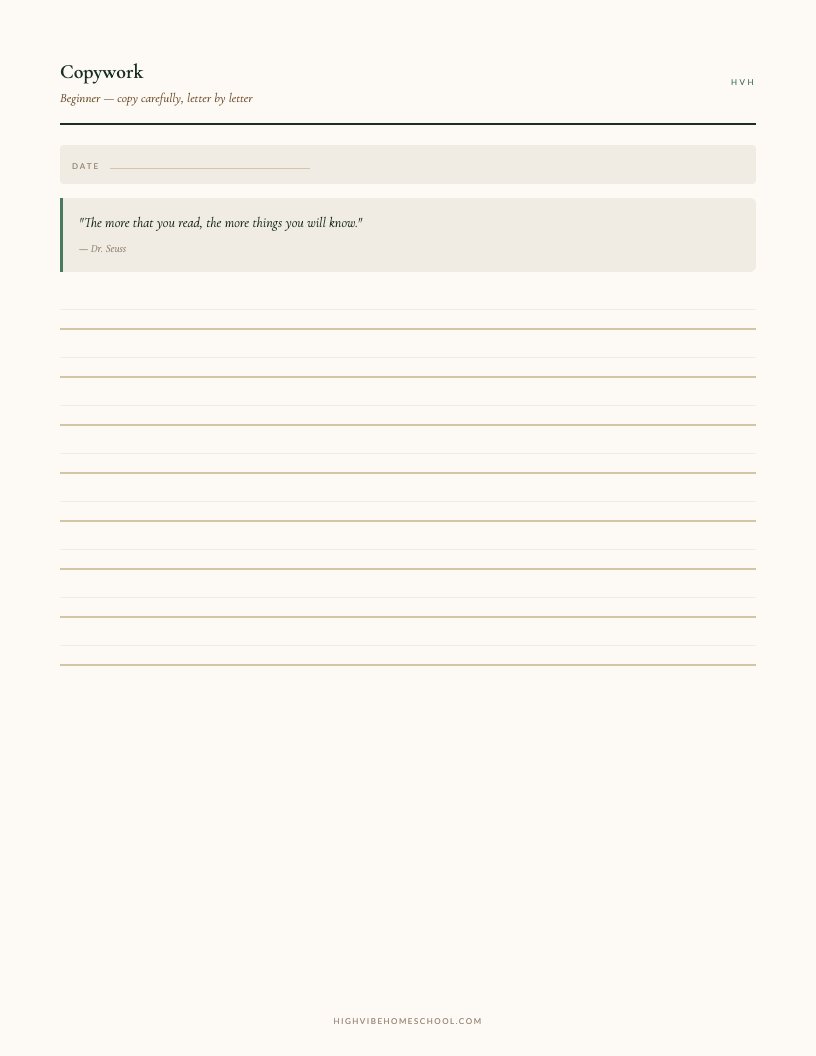
Free Download
Copywork Pages
6 pages of handwriting practice: 3 beginner pages with large lines and 3 intermediate pages, botanical header on each.
No spam. Unsubscribe anytime.
Teaching writing at home goes deeper on the composition component of language arts. And homeschool spelling addresses the subject most parents worry about — with the research showing it is probably not where to focus your energy.
Written by
The High Vibe Homeschool Team
We are a homeschool family that has been doing this for seven years across three kids. We write about what we have actually tried, what failed, what surprised us, and what we would do again. No credentials. Just lived experience.
ENJOYED THIS ARTICLE?
Get more like it every week
Real homeschool life, in your inbox.
Keep Reading
More in Curriculum
 Curriculum
Math Games That Make Numbers Come Alive (Even for the Kid Who Hates Math)
My son cried at math worksheets for two years. Then we found games. Here are the ones that changed everything — no flashcards required.
 Curriculum
Living Books: What They Are and How to Find Them
Charlotte Mason's term for books that feel alive. Here's what makes a book 'living,' why it matters, and a list of the ones that have done the most for our homeschool.
 Curriculum
Teaching Writing at Home (When You Don't Feel Like a Writing Teacher)
Writing is the subject most homeschool parents fear most. Here's how we finally made it work — and the approach that produces the most growth for the least friction.