
Charlotte Mason for Complete Beginners: What It Actually Looks Like in Real Life
Charlotte Mason sounds beautiful in theory. But what does it actually look like on a Tuesday morning? A practical, grounded introduction for families who are curious but a little overwhelmed.
If you have spent any time in homeschool communities, you have probably seen the gorgeous Charlotte Mason aesthetics. Nature journals filled with careful watercolor sketches. Stacks of beautiful hardcover books. Children reading Shakespeare in meadows.
It is stunning. It is also a little intimidating.
Here is what I want you to know: Charlotte Mason is one of the most accessible homeschool methods out there, once you strip away the Instagram version and look at what it actually involves. You do not need a farmhouse. You do not need to be an artist. You do not need to spend a lot of money.
What you need is to understand a few core ideas and then put them into practice, imperfectly and consistently.
Who Was Charlotte Mason?
Charlotte Mason was a British educator who lived from 1842 to 1923. She developed a philosophy of education that was radically different from what was happening in schools at the time. She believed children are born persons, full human beings deserving of a rich intellectual and spiritual life. She believed education should be a feast, not a force-feeding.
Her ideas were gathered into a series of volumes called the Original Home Education Series, which you can read for free online. I would not start there, though. Start here, with the practical stuff.
The Core Ideas, Plain and Simple
Living books over textbooks. A living book is one written by a real person who loved their subject, in narrative form that draws you in. Think of a book that reads like a story even when it is teaching you something. Compare that to a dry textbook that presents facts in bullet points. Living books connect. They make you care. Charlotte Mason believed children learn better and remember more when they read (or hear) living books rather than abridged, dumbed-down summaries.
Narration instead of worksheets. After your child reads or hears a passage, you ask them to tell it back to you. That is it. No quiz. No fill-in-the-blank. Just: "Tell me what happened." Or "Tell me the most interesting thing you learned." This process forces the child to process, organize, and own the information. It sounds simple but it is genuinely powerful.
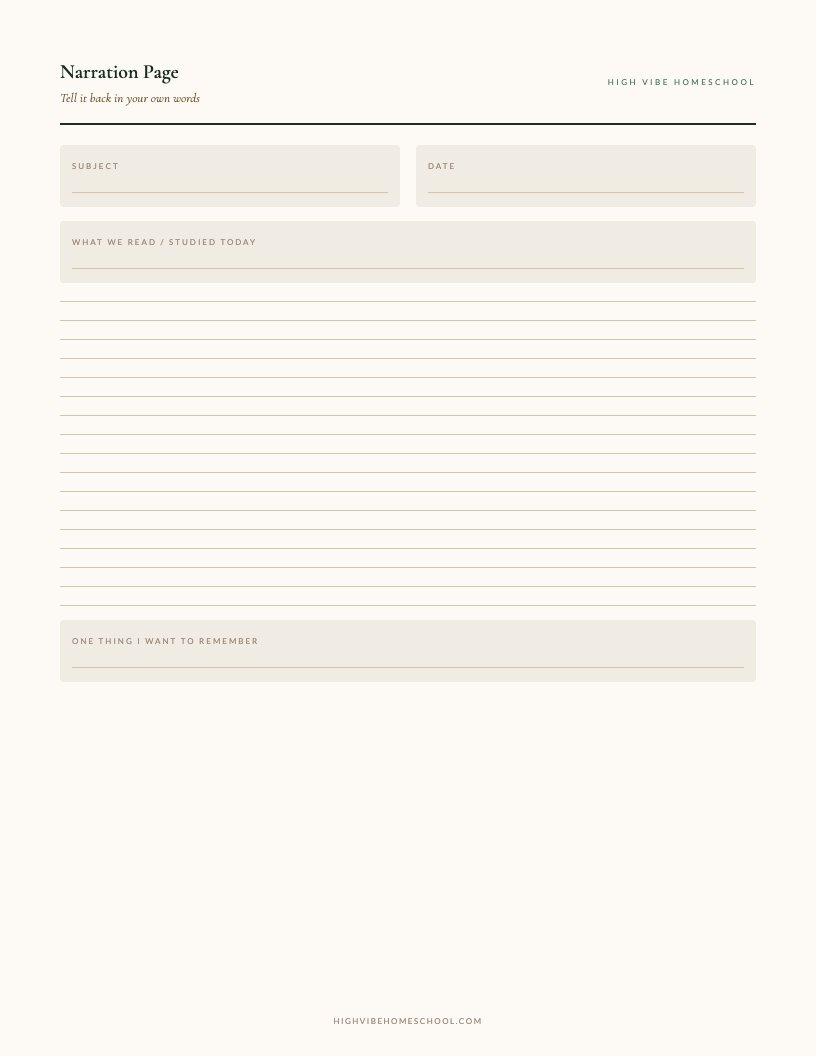
Free Download
Charlotte Mason Notebooking Pages
4 pages for recording what your child is learning: lined narration, drawing box, nature entry, and free study.
No spam. Unsubscribe anytime.
Nature study. Charlotte Mason was passionate about children spending real time outdoors, not just playing but observing. Keeping a nature journal, noticing seasonal changes, sketching what they find. This does not need to be fancy. It can be a walk in your neighborhood and a sketchbook from the dollar store.
Short lessons. She believed in keeping lessons short, especially for younger children. Twenty minutes on one subject, then switch. The idea is that focused attention for a short time is more valuable than a child glazing over for an hour. This is one of my favorite things about CM because it means your school day can actually end.
Habits and atmosphere. Mason placed enormous weight on the atmosphere of the home, the habits of the child, and the ideas they are surrounded by. She believed good habits, once formed, run almost on autopilot and free up mental energy for real learning.
What a Charlotte Mason Morning Actually Looks Like
Let me give you a real example. This is not perfect. It is not Pinterest-worthy. But it is real.
We start with morning time together. That might be fifteen minutes of reading from a picture book about history, followed by everyone saying back their favorite part. Then we move to twenty minutes of math with a curriculum we like (CM is flexible on math). Then my younger one does copywork, which means she copies a beautiful sentence or short passage by hand, focusing on handwriting and on the content of what she is writing. My older one does a nature journal entry from our walk yesterday.
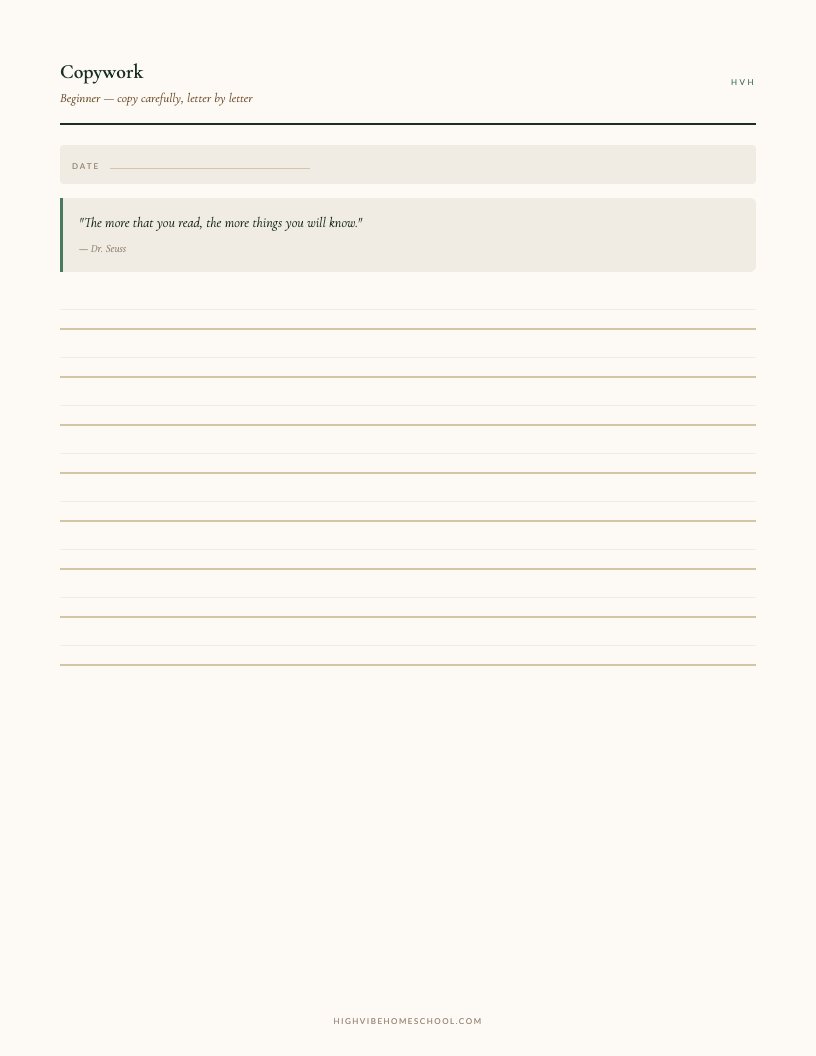
Free Download
Copywork Pages
6 pages of handwriting practice: 3 beginner pages with large lines and 3 intermediate pages, botanical header on each.
No spam. Unsubscribe anytime.
We read aloud from a chapter of a living book together after lunch. Right now it is a biography of a historical figure. Before bed we often read poetry. Not because I am trying to check a box but because we like it.
That is it. We are done in about three hours, sometimes less.
The Biggest Misconception
People think Charlotte Mason is just reading beautiful books and going on nature walks. And yes, those are real parts of it. But the philosophy underneath is actually quite rigorous. The expectation is that children will encounter big ideas, complex language, and challenging content, and will be trusted to meet them. You are not simplifying things for your child. You are bringing them into the real thing.
There is also a misconception that CM is only for certain types of kids. I hear this a lot. "My kid is too active for that." But narration can be done orally while playing with Legos. Nature study can be thirty minutes running around a creek. Living books can be audiobooks in the car. The method is flexible enough to meet your real child.
Where to Start
If I were beginning tomorrow, I would do three things. First, I would go to AmblesideOnline.org, which is a free Charlotte Mason curriculum for all grades. Browse the Year 1 book list and check a few titles out of the library. Second, I would start doing oral narration after any reading we do together, even if it feels awkward at first. Third, I would take my kids outside for at least thirty minutes and bring a sketchbook.
That is Charlotte Mason. You already know how to do this.
Charlotte Mason's most distinctive practices are the nature journal and the morning basket. We have written about nature journaling as a practice and the morning basket in more depth if you want to start with just one thing. For how Charlotte Mason compares to classical education, see classical education at home.
Written by
The High Vibe Homeschool Team
We are a homeschool family that has been doing this for seven years across three kids. We write about what we have actually tried, what failed, what surprised us, and what we would do again. No credentials. Just lived experience.
ENJOYED THIS ARTICLE?
Get more like it every week
Real homeschool life, in your inbox.
Keep Reading
More in Curriculum
 Curriculum
Math Games That Make Numbers Come Alive (Even for the Kid Who Hates Math)
My son cried at math worksheets for two years. Then we found games. Here are the ones that changed everything — no flashcards required.
 Curriculum
Living Books: What They Are and How to Find Them
Charlotte Mason's term for books that feel alive. Here's what makes a book 'living,' why it matters, and a list of the ones that have done the most for our homeschool.
 Curriculum
Teaching Writing at Home (When You Don't Feel Like a Writing Teacher)
Writing is the subject most homeschool parents fear most. Here's how we finally made it work — and the approach that produces the most growth for the least friction.